Welding Cable Size Chart and Calculator
Enter the welding current and the length of your leads to get the smallest cable that keeps the voltage drop within your limit, and a full sizing chart.
This free welding cable size calculator finds the smallest welding lead that keeps voltage drop within your limit, using the same voltage-drop method behind welding cable size charts. Enter your welding current and cable length, and it shows the cable size, its voltage drop, and the power lost as heat. It runs in your browser, needs no sign-up, and works on a phone.
It checks sizes from AWG 8 to 4/0 and from 10 mm² to 120 mm², so you can compare its result with a welding cable sizing chart for your own run. Use the results for planning, quotes, procedures, or shop paperwork.
How to use the welding cable size calculator
- Enter the welding current in amps (A).
- Choose feet or metres, then enter the cable length.
- Choose what the length means. “Distance to the work” counts the electrode lead and work lead together as twice this distance. “Total of both leads” uses the length you enter as the full cable length.
- Set the allowed voltage drop. It defaults to 2 V; change it if your job needs a different limit.
- Open More options and pick the cable temperature, 20 °C or 75 °C.
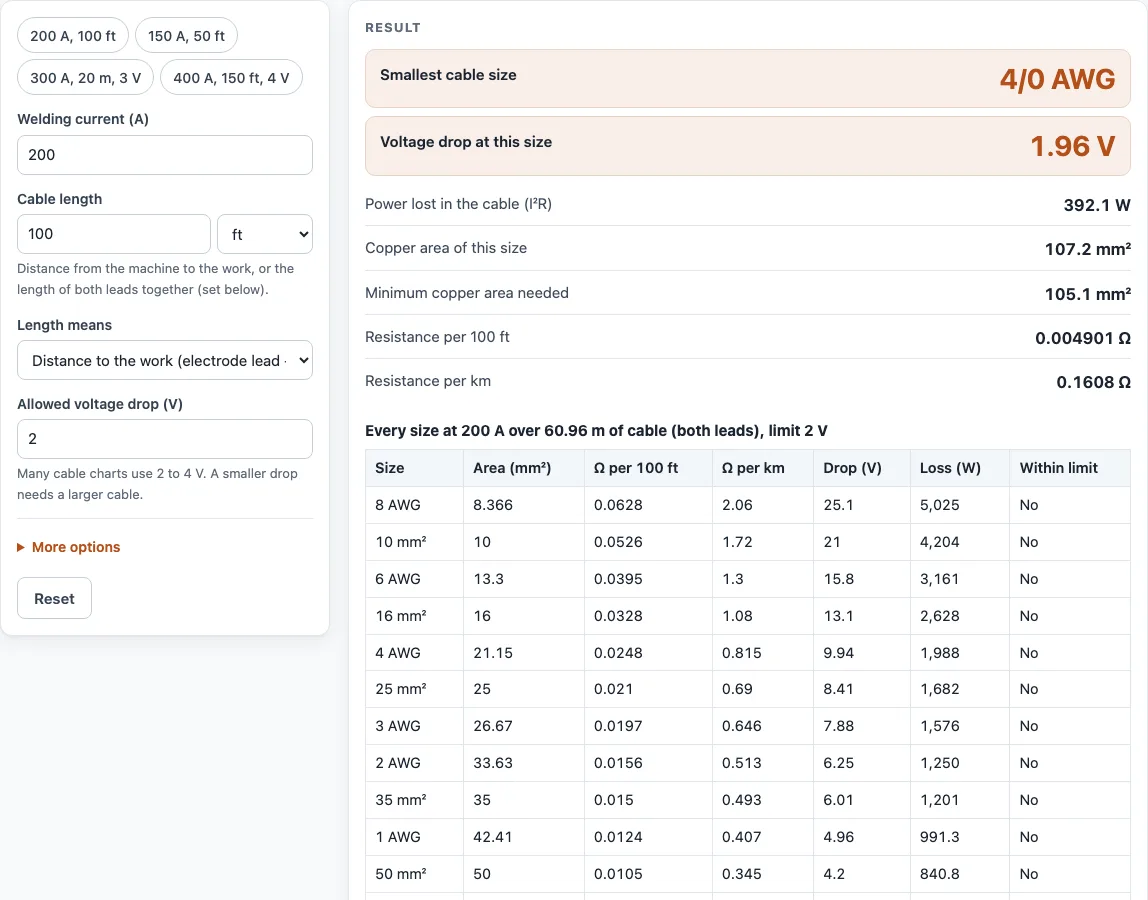
- Read the result: the smallest cable size, its voltage drop and power loss, copper area, minimum area needed, and resistance per 100 ft and per km.
- Scroll down to the table of every size at your current and length, and the sizing chart of 100–500 A against 25–200 ft (or 5–50 m) at your drop limit.
Results update as you type, so you can change one input at a time. Open “How it was calculated” to see each formula step with your numbers. Copy result copies the result lines with a link. Copy link copies the page address, which stores every input (?s=…), so opening it later restores the same calculation. Print / save as PDF prints the inputs, results, calculation steps, and the date.
What size welding cable do I need?
The right size is the smallest cable whose voltage drop over the whole circuit stays within your limit. This calculator and most welding cable size charts use that rule. It tests each size from AWG 8 up to 4/0 and metric 10 to 120 mm², then picks the first one that passes.
Voltage drop equals current multiplied by the resistance of the circuit. For copper, resistance depends on the cable’s cross-section: a thicker cable has less resistance. The calculator uses annealed copper with a resistivity of 1.7241 × 10⁻⁸ Ω·m at 20 °C. At 75 °C the resistance rises, using a temperature coefficient of 0.00393 per °C. Power lost as heat is I² × R, so a larger drop also means more wasted energy in the cable.
Why does welding cable length matter?
Length matters because current flows out through the electrode lead and back through the work lead. Every extra foot or metre adds resistance, so doubling the length doubles the voltage drop. A cable that passes at 50 ft may fail at 100 ft with the same current.
The calculator’s examples show how this changes the size:
- 200 A, 100 ft to the work, 2 V limit, 20 °C: 4/0 AWG, drop 1.96 V, loss 392 W.
- 150 A, 50 ft to the work, 2 V limit, 20 °C: 1 AWG, drop 1.86 V, loss 279 W.
- 300 A, 20 m to the work, 3 V limit, 20 °C: 70 mm², drop 2.96 V, loss 887 W.
- 250 A, 75 ft total of both leads, 2 V limit, 75 °C: 2/0 AWG, drop 1.78 V, loss 444 W.
Notice that 100 ft to the work already means 200 ft of cable in the circuit. Check which length type you are using before you read the result.
Sources
Checked October 2026:
- Wikipedia, American wire gauge for AWG diameters and areas; copper resistivity 1.7241 × 10⁻⁸ Ω·m at 20 °C (IACS, NBS Handbook 100)
- Industrial Cord welding cable spec sheet: sizes based on a 4 V drop over the whole circuit (welding and ground leads); this tool’s results agree with it within one AWG size
- Metric sizes are the common 10 to 120 mm² conductor sizes; areas are nominal, so fine-stranded cable has slightly higher resistance
For estimation; verify critical designs against the applicable standard.
Worked examples
| Input | Result |
|---|---|
| 200 A, 100 ft (Distance to the work (electrode lead + work lead = 2 x this)), limit 2 V, 20 °C | 4/0 AWG, drop 1.96 V, loss 392 W |
| 150 A, 50 ft (Distance to the work (electrode lead + work lead = 2 x this)), limit 2 V, 20 °C | 1 AWG, drop 1.86 V, loss 279 W |
| 300 A, 20 m (Distance to the work (electrode lead + work lead = 2 x this)), limit 3 V, 20 °C | 70 mm², drop 2.96 V, loss 887 W |
| 250 A, 75 ft (Total length of both leads), limit 2 V, 75 °C | 2/0 AWG, drop 1.78 V, loss 444 W |
Calculated by the tool above with these values.
Frequently asked questions
How do you size welding cable for amps and length?
Start with your welding current and the distance from the machine to the work. Choose the length type, keep or change the voltage-drop limit, and read the smallest cable that passes. Higher current and longer leads both push the required size up.
What size welding lead for 200 amps?
There is no single answer, because length decides it. For 200 A at 100 ft to the work with a 2 V limit, the calculator gives 4/0 AWG. Enter your own distance to get the size for your run.
What is 1/0, 2/0 and 4/0 welding cable?
These are AWG sizes where “0” is written as “aught”: 1/0 is one-aught, 2/0 is two-aught, and 4/0 is four-aught. They are thicker than 1 AWG. AWG numbers run backwards, so the smaller the number, the thicker the cable. Among these three, 4/0 is the thickest and 1/0 is the thinnest.
Is welding cable size the same as ampacity?
No. This calculator sizes cable by voltage drop only. Ampacity is how much current a cable can carry without overheating, and the cable maker’s ampacity table gives that figure. Duty cycle is also separate. On short runs, the ampacity table can call for a larger cable than the voltage-drop result, so check both.
What drop limit should I use?
The default is 2 V, which is the value used in the calculator’s examples. You can change it under the limit input if your job calls for a different figure. A drop above 4 V is more than the 4 V basis of common welding cable charts, such as the Industrial Cord welding cable table.
Related tools
- MIG wire size chart: Use it when you need to match wire diameter to your MIG setup.
- Heat input calculator: Use it to estimate heat input for a weld procedure.
- Welding cost calculator: Use it to estimate what a welding job costs.
- Welding shade chart: Use it to choose a lens shade for your welding process.
- All welding calculators: Use it to browse every welding tool on the site.