Carbon Equivalent Calculator
Enter the steel's chemical composition from the mill certificate to get its carbon equivalent by the IIW, Pcm and CET formulas.
The carbon equivalent calculator works out the carbon equivalent (CE) of a steel from its chemical composition, using the IIW, Pcm and CET formulas. Enter the weight percentages from the mill certificate, and the three results update as you type. It runs in your browser, is free, needs no sign-up, and works on a phone.
Use it to compare steels before you plan welding, choose a preheat method, or write a procedure. The calculator gives you the numbers and the steps behind them. The preheat temperature itself comes from the welding code you are working to.
Leave an element blank or at 0 if the certificate does not list it.
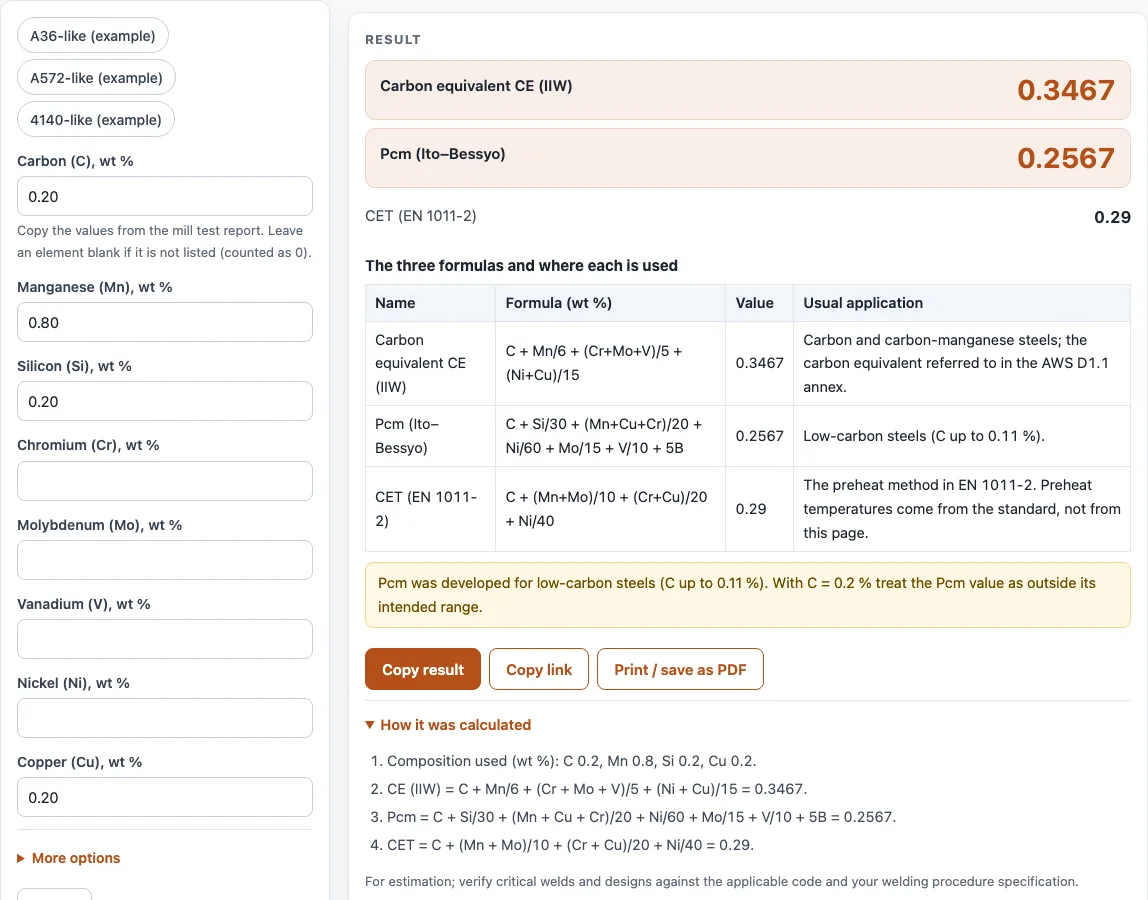
How to use the Carbon Equivalent Calculator
- Find the chemical composition on the mill certificate for your steel. Note the weight % for C, Mn, Si, Cr, Mo, V, Ni and Cu.
- Type each value into its box. Enter 0 for any element that the certificate does not list.
- If the certificate lists boron, open More options and enter B.
- Read CE (IIW), Pcm and CET in the results. They update as you type.
- If you entered a carbon value above 0.11 %, read the warning before you use Pcm.
- Open How it was calculated to see the formula and each substitution with your numbers.
You can also load a preset. Presets are labelled example compositions, not certified grades, so replace the values with your certificate figures before you use the results.
Use Copy result to copy the result lines with a link. Copy link copies the page address, which stores every input in the ?s= part of the URL, so opening it later restores the same calculation. Print / save as PDF prints the inputs, results, calculation steps and the date, which is useful for shop paperwork.
The presets load three example compositions (A36-like, A572-like and 4140-like) so you can compare a mild steel, a higher-strength structural steel and an alloy steel.
What is the carbon equivalent formula?
The carbon equivalent formula is a weighted sum of the carbon and alloying elements in a steel, giving one number that rates how demanding the steel is to weld. The most common version is the IIW formula: CE = C + Mn/6 + (Cr + Mo + V)/5 + (Ni + Cu)/15, with every value in weight %.
Carbon has the largest weight in the sum, so it drives the result for plain carbon steels.
How do you calculate carbon equivalent for steel?
Replace each symbol with the weight % of that element from the mill certificate, using 0 for elements that are not present. Then do the divisions and add the terms together. For C 0.20, Mn 0.80, Si 0.20 and Cu 0.20, the IIW formula gives 0.20 + 0.80/6 + 0.20/15 = 0.347. Silicon is not part of the IIW formula, so it does not change this result.
What is the difference between CE, Pcm and CET?
CE (IIW), Pcm and CET are three formulas that estimate the same risk, but they weight the elements differently and suit different steels. CE (IIW) is used for carbon-manganese and low-alloy steels, for example in EN 1011-2 preheat method A. Pcm is used for low-carbon steels with C up to about 0.11 % and in the AWS D1.1 Annex B preheat method, and CET is used in EN 1011-2 preheat method B.
The same composition can give three different numbers. For C 0.20, Mn 0.80, Si 0.20 and Cu 0.20, the results are CE 0.347, Pcm 0.257 and CET 0.29. Because that carbon level is above 0.11 %, Pcm is the least suitable of the three for this steel.
What does carbon equivalent mean for weldability?
A higher carbon equivalent means a steel is more likely to form a hard heat-affected zone, and that hardness raises the risk of hydrogen cracking after welding. The higher the value, the more care the weld needs. For example, the example composition labelled 4140-like (C 0.40, Mn 0.85, Cr 0.95, Mo 0.20) gives CE 0.772, which is far above the 0.347 of the first example. That result points to a weld that needs more preheat and low-hydrogen practice.
Does carbon equivalent tell me the preheat?
No. The carbon equivalent measures the risk, but the preheat temperature comes from the welding code you are working to, such as AWS D1.1 or EN 1011-2. Use the carbon equivalent formula that code names, then read the preheat from its tables.
Sources
Checked October 2026:
- Wermac, Carbon equivalent and preheat: CE (IIW), Pcm and CET formulas, their use in EN 1011-2 and AWS D1.1 Annex B, and the CE (IIW) method A range
- Dillinger welding calculator help: CET formula and its range of validity
- What Is Piping, Carbon equivalent for the Ito–Bessyo Pcm and its low-carbon range
For estimation; verify critical designs against the applicable standard.
Worked examples
| Input | Result |
|---|---|
| C 0.20, Mn 0.80, Si 0.20, Cu 0.20 wt % | CE(IIW) 0.347, Pcm 0.257, CET 0.29 |
| C 0.20, Mn 1.20, Si 0.25, V 0.03, Cu 0.15 wt % | CE(IIW) 0.416, Pcm 0.279, CET 0.328 |
| C 0.40, Mn 0.85, Si 0.25, Cr 0.95, Mo 0.20 wt % | CE(IIW) 0.772, Pcm 0.512, CET 0.553 |
| C 0.08, Mn 1.50, Si 0.30, Cr 0.20, Mo 0.10, V 0.05, Ni 0.50, Cu 0.30, B 0.002 wt % | CE(IIW) 0.453, Pcm 0.22, CET 0.278 |
Calculated by the tool above with these values.
Frequently asked questions
Which formula should I use for low-carbon steel?
Use the Pcm result for low-carbon steels with C up to 0.11 %. The calculator shows a warning when C is above that level, so check the note before you choose Pcm.
Can I enter boron for my steel?
Yes. Boron is under More options, and Pcm includes it as 5B. Enter it only if the mill certificate lists a boron value.
Can I use the results in quotes and shop paperwork?
Yes. Results may be used in commercial work, such as quotes, welding procedure planning, shop paperwork and reports, without attribution. Print / save as PDF gives you a dated record of the inputs and steps.
How do I save a calculation and come back to it later?
Click Copy link to copy the page address. That address stores every input in the ?s= part of the URL, so opening it later restores the same calculation.
Do the example compositions match real steel grades?
No. Presets are labelled example compositions, not certified grades. For real work, enter the values from your own mill certificate.
Why is silicon in Pcm but not in CE (IIW)?
Pcm includes silicon at Si/30 and boron at 5B, while the IIW formula leaves both out. Enter Si anyway; the IIW result simply ignores it.
Related tools
- Heat input calculator: use it to work out the heat input for a welding procedure you are planning.
- Weld strength calculator: use it when you need to check the strength of a weld.
- Welding rod chart: use it to look up filler rods when you are choosing consumables.
- Metal melting point chart: use it to compare the melting points of different metals.
- All welding calculators: use it to see the full list of tools on the site.