Welding Gas Bottle Size Chart
Look up argon, CO2, oxygen and acetylene cylinder sizes and see how long a bottle lasts at your flow rate.
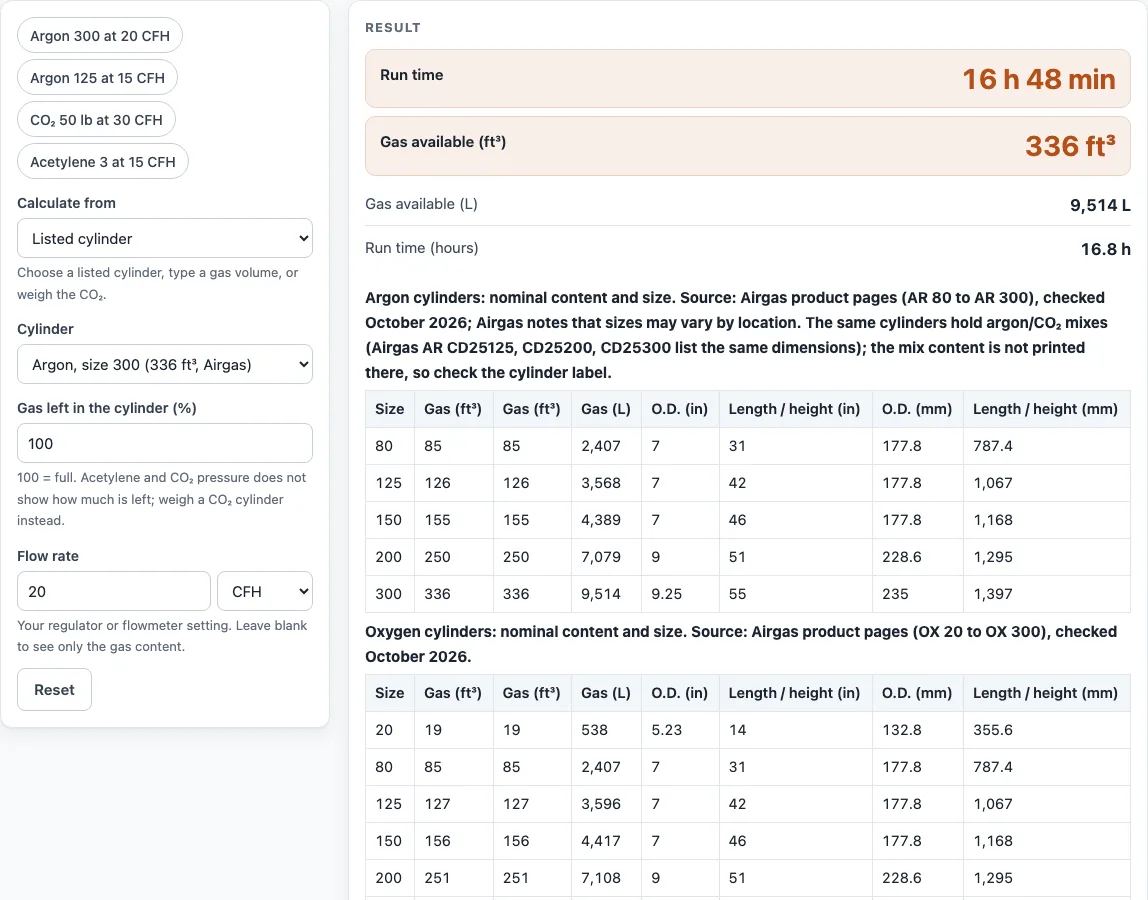
How to use the welding gas bottle size chart
- Under “Calculate from”, choose Listed cylinder, Gas volume or CO₂ weight.
- For a listed cylinder, pick the gas and size, such as argon size 300 or acetylene size 3. If you have a gas volume instead, enter it and its unit, and tick “The gas is acetylene” when it is.
- For a part-used argon or oxygen cylinder, enter the percentage in “Gas left in the cylinder (%)”.
- For CO₂, enter the weight of liquid in the cylinder. Weigh the cylinder, because pressure does not show how much liquid remains.
- Enter your flow rate and select its unit: CFH, L/min or m³/h.
- Read the gas content and the run time. Results update as you type.
- For acetylene, the page checks your flow against the withdrawal limit, so read that result before you set your regulator.
- Open “How it was calculated” to see the formula and each step with your numbers.
Copy result copies the result lines with a link. Copy link copies the page address, which stores every input, so opening it later restores the same calculation. Print / save as PDF prints the inputs, results, calculation steps and the date. The tool works on a phone too.
What sizes do argon, CO₂ and oxygen cylinders come in?
Argon, oxygen, acetylene and CO₂ cylinders each come in several numbered sizes, and each size has a nominal gas content and set of outside dimensions. Airgas lists argon size 300 at about 336 ft³, 9.25 in outside diameter and 55 in long, and argon size 200 at about 250 ft³, 9 in by 51 in. Oxygen size 300 is listed at about 337 ft³, and the chart lists oxygen sizes from 20 to 300.
For acetylene tank sizes, the chart lists B, 3, 4, 4.5 and 5. Size 3 holds 65 ft³, and Airgas lists size 5 at about 323 ft³, measuring 12 in by 46.7 in with cap and valve. The table under the result gives the acetylene tank dimensions (outside diameter and length) for every size Airgas prints them for; size 4.5 is listed without dimensions because the Airgas page prints an impossible height for it.
CO₂ is sold by weight of liquid, not by gas volume. Airgas lists 50 lb in a size 200 cylinder and 73 lb in a size 300 cylinder, while Norris Cylinder lists 5, 10, 15 and 20 lb cylinders. To convert pounds to gas, the calculator uses 8.79 ft³ per pound at 70 °F and 1 atm, from the Airgas Pure Gases catalog.
Argon/CO₂ mixes, such as Airgas 25% CO₂ in argon, use the same cylinder dimensions as argon. The content of a mix is not printed on those pages, so take it from your label.
How long will an argon tank last at 20 CFH?
A full Airgas size 300 argon cylinder, about 336 ft³, lasts about 16 hours 48 minutes at 20 CFH. Run time is the gas content divided by the flow rate, so 336 ÷ 20 = 16.8 hours, which is 16 h 48 min.
The same formula works for part-used cylinders. A size 125 argon cylinder (126 ft³) at 50% left holds 63 ft³, which lasts 4 h 12 min at 15 CFH.
For acetylene, the withdrawal limit is based on the full cylinder capacity per hour, not on what is left. A size 3 cylinder at 100% holds 65 ft³ and lasts 4 h 20 min at 15 CFH, but the flow limit still applies to its full capacity.
Sources
Checked October 2026 (sizes and contents vary by supplier and location; check your cylinder label):
- Airgas product pages for argon (AR 80–300), oxygen (OX 20–300), acetylene (AC B–5), CO₂ (CD 50–100) and argon/CO₂ mixes, e.g. argon size 300
- Norris Cylinder, specialty cylinder specifications: 5–20 lb CO₂ cylinders
- Airgas Pure Gases catalog, carbon dioxide: 8.79 ft³ of gas per lb at 70 °F, 1 atm
- Acetylene withdrawal: Oregon OAR 437-002-2102 (1/7 per hour); CGA G-1 as quoted in AWS Inspection Trends, Nov 2024 (1/10 intermittent, 1/15 permanent)
For estimation; verify critical designs against the applicable standard.
Worked examples
| Input | Result |
|---|---|
| Argon, size 300 (336 ft³, Airgas), 100 % left | 336 ft³ (9,514 L) of gas, lasts 16 h 48 min at 20 CFH |
| Argon, size 125 (126 ft³, Airgas), 50 % left | 63 ft³ (1,784 L) of gas, lasts 4 h 12 min at 15 CFH |
| CO₂, 50 lb, size 200 (Airgas), 100 % left | 439.5 ft³ (12,450 L) of gas, lasts 14 h 39 min at 30 CFH |
| Acetylene, size 3 (65 ft³, Airgas), 100 % left | 65 ft³ (1,841 L) of gas, lasts 4 h 20 min at 15 CFH |
| 10 kg of liquid CO₂ | 193.8 ft³ (5,487 L) of gas, lasts 7 h 37 min at 12 L/min |
Calculated by the tool above with these values.
Frequently asked questions
How many cubic feet are in a size 300 argon tank?
A full Airgas size 300 argon cylinder holds about 336 ft³, which is about 9,514 L. Check the label on your own cylinder, because the figure on the chart is nominal.
How many cubic feet of gas are in a 20 lb or 50 lb CO₂ tank?
A 20 lb CO₂ cylinder holds about 175.8 ft³ (20 × 8.79), and a 50 lb cylinder holds about 439.5 ft³. These figures use 8.79 ft³ per pound at 70 °F and 1 atm.
How do I know how much CO₂ is left in my cylinder?
Weigh the cylinder, because pressure does not show how much liquid is left. As a worked example, 10 kg of liquid CO₂ gives 193.8 ft³ (5,487 L), which lasts about 7 h 37 min at 12 L/min.
What is the acetylene withdrawal limit?
The limit is a fraction of the full cylinder capacity drawn per hour. The page uses 1/7 from Oregon OAR 437-002-2102, or 1/10 for intermittent use and 1/15 for permanent installations, from CGA G-1. Use the tighter 1/10 limit for work that is sensitive to solvent carry-over.
Can I use the calculator for an argon/CO₂ mix?
Yes. Enter the content from your label, because the mix pages do not print it. The cylinder dimensions are the same as for argon.
Are cylinder sizes the same at every supplier?
No. Airgas states that sizes may vary by location, and other suppliers use different sizes. Check your cylinder label before you plan a run.
Related tools
- TIG cup size chart: use it to pick the right gas lens or cup size for your torch.
- MIG welding settings chart: use it to set wire feed and voltage for MIG work.
- Welding cost calculator: use it to estimate the cost of a welding job, including gas use.
- Welding shade chart: use it to choose the correct lens shade for your process.
- TIG amperage chart: use it to find a starting amperage for TIG welding.
- All welding calculators: use it to browse every calculator on the site.