Heat Input Calculator for Welding
Enter voltage, current and travel speed (or bead length and arc time) to get the arc energy and heat input in kJ/in and kJ/mm.
The heat input calculator works out how much heat a weld puts into the base metal, using arc voltage, current and travel speed. It shows the result in kJ/in, kJ/mm and J/mm, and it can also work backwards to find the travel speed needed for a target heat input. Use it as a heat input welding calculator when you plan a weld or check a welding procedure.
The tool runs in your browser. It is free, needs no sign-up, and uploads nothing. You can choose a welding process such as MIG, TIG, stick or submerged arc, and the calculator applies the matching efficiency factor. Results appear as you change the numbers, so you can compare settings quickly.
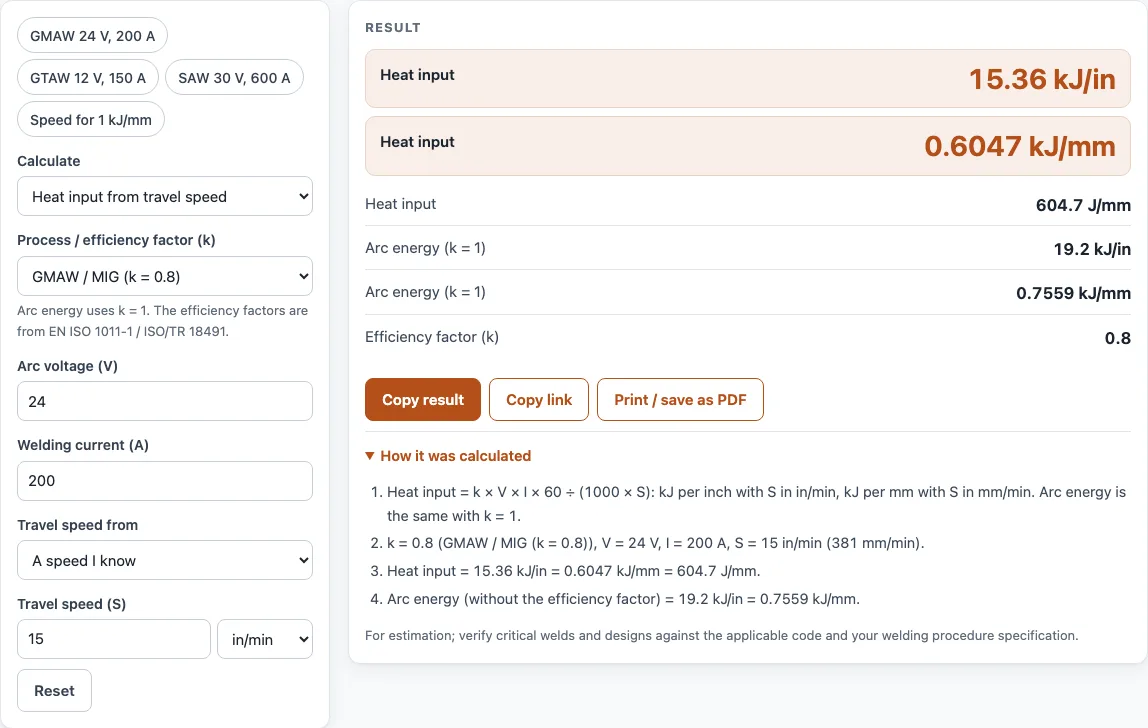
How to use the Heat input calculator
- Choose a mode: heat input from travel speed, or the travel speed needed for a target heat input.
- Select your welding process, such as GMAW / MIG, GTAW / TIG, SMAW / stick, SAW, or Arc energy (k = 1, the value American codes call heat input). The process sets the efficiency factor k.
- Enter the arc voltage (V) in volts.
- Enter the welding current (I) in amps.
- Enter the travel speed. Type it directly in in/min or mm/min, or work it out from bead length and arc time: speed = length ÷ time.
- Read the results: heat input in kJ/in, kJ/mm and J/mm, the arc energy when k is below 1, and travel speed in in/min, mm/min and mm/s.
- Check any warning. The tool flags voltage above 60 V or current above 1500 A, so confirm the units before you use the result.
Open How it was calculated to see the formula with each step and your numbers. Copy result copies the result lines with a link. Copy link copies the page address, which stores every input (in the ?s=… part), so opening it later restores the same calculation. Print / save as PDF prints the inputs, results, calculation steps and the date.
The presets show a GMAW, a GTAW and a SAW example and a speed for a 1 kJ/mm target.
What is the heat input formula in welding?
Heat input is calculated as HI = (V × I × 60) ÷ (1000 × S) × k. V is arc voltage in volts, I is current in amps, and S is travel speed. With S in in/min the result is in kJ/in; with S in mm/min it is in kJ/mm.
How do you calculate heat input?
Multiply voltage by current and by 60, divide by 1000 times the travel speed, then multiply by k. For example, take 24 V, 200 A, GMAW at 15 in/min with k = 0.8: 24 × 200 × 60 = 288,000; 1000 × 15 = 15,000; 288,000 ÷ 15,000 = 19.2; 19.2 × 0.8 = 15.36 kJ/in. Divide by 25.4 to get kJ/mm: 0.6047 kJ/mm.
What is the difference between arc energy and heat input?
Arc energy is the same formula with k = 1; as TWI notes, a number of American codes use the term heat input for it. It gives the electrical energy the arc delivers per unit length of weld. Heat input applies a thermal efficiency factor below 1 for most processes, which estimates the heat actually transferred into the plate. The calculator shows the arc energy whenever k is less than 1. For example, 24 V and 200 A at 300 mm/min give an arc energy of 0.96 kJ/mm (24.38 kJ/in).
What efficiency factor for MIG and TIG?
For MIG (GMAW), use k = 0.8. For TIG (GTAW), use k = 0.6. The ISO/TR 18491 values, as published by TWI and Weld Australia, are: SAW 1.0; SMAW, GMAW and cored wire (FCAW, MCAW) 0.8; GTAW and PAW 0.6. Choose your process in the tool and the factor is applied for you. As a check, 12 V and 150 A GTAW at 100 mm/min with k = 0.6 gives 0.648 kJ/mm (16.46 kJ/in).
How do I find travel speed for a heat input?
Rearrange the formula to S = (V × I × 60 × k) ÷ (1000 × HI), where HI is in kJ/mm and S is in mm/min. Divide mm/min by 25.4 to get in/min, or by 60 to get mm/s. For example, a target of 1 kJ/mm with SMAW at 24 V and 130 A (k = 0.8) needs 149.8 mm/min, or 5.896 in/min.
Sources
Checked October 2026:
- TWI, Difference between heat input and arc energy: efficiency factors SAW 1.0; MMA, MIG/MAG and cored wire 0.8; TIG and plasma 0.6
- Weld Australia travel speed calculator for the same factors from ISO/TR 18491
- Arc energy = V × I × 60 ÷ (1000 × travel speed) in kJ per unit length
For estimation; verify critical designs against the applicable standard.
Worked examples
| Input | Result |
|---|---|
| 24 V, 200 A, GMAW / MIG (k = 0.8), 15 in/min | 15.36 kJ/in = 0.6047 kJ/mm |
| 24 V, 200 A, Arc energy (k = 1; American codes call it heat input), 300 mm/min | 24.38 kJ/in = 0.96 kJ/mm |
| 12 V, 150 A, GTAW / TIG (k = 0.6), 100 mm/min | 16.46 kJ/in = 0.648 kJ/mm |
| 30 V, 600 A, SAW (k = 1.0), 20 in/min | 54 kJ/in = 2.126 kJ/mm |
| 24 V, 130 A, SMAW / stick (k = 0.8), 1 kJ/mm | 5.896 in/min (149.8 mm/min) |
Calculated by the tool above with these values.
Frequently asked questions
Does the heat input calculator set a limit for my weld?
No. Heat input limits come from your welding procedure specification (WPS). Compare your result with the minimum and maximum in the WPS.
What do the voltage and current warnings mean?
The tool flags voltage above 60 V or current above 1500 A as a unit check. Look for a unit or typing error before you rely on the result.
Why does the result change as I type?
Results update as you type, so each change to voltage, current, speed or process shows straight away. Use this to test settings before you commit to a value.
Does it work on a phone?
Yes. The calculator works on a phone because everything runs in the browser, and your inputs are not uploaded.
Can I use the results in quotes or shop paperwork?
Yes. You may use the results in commercial work, such as quotes, welding procedure planning, shop paperwork and reports, without attribution. Print / save as PDF gives you a dated record of inputs and steps.
Can I enter the bead length and time instead of a speed?
Yes. Choose bead length and arc time under travel speed; the tool divides length by time to get the speed and shows it in in/min, mm/min and mm/s.
Related tools
- Carbon equivalent calculator: use it to estimate carbon equivalent when you assess how a steel will respond to welding heat.
- Weld strength calculator: use it to check the strength of a weld joint against your design load.
- Welding cost calculator: use it to estimate the cost of a welding job before you quote.
- Welding cable size chart: use it to look up a suitable cable size for your welding current.
- MIG wire size chart: use it to compare MIG wire diameters for your job.
- All welding calculators: use it to browse every calculator on the site.