Metal Melting Point Chart
Look up the melting point of a pure metal in °C, °F and K, or enter a temperature to see which metals are solid or molten at it.
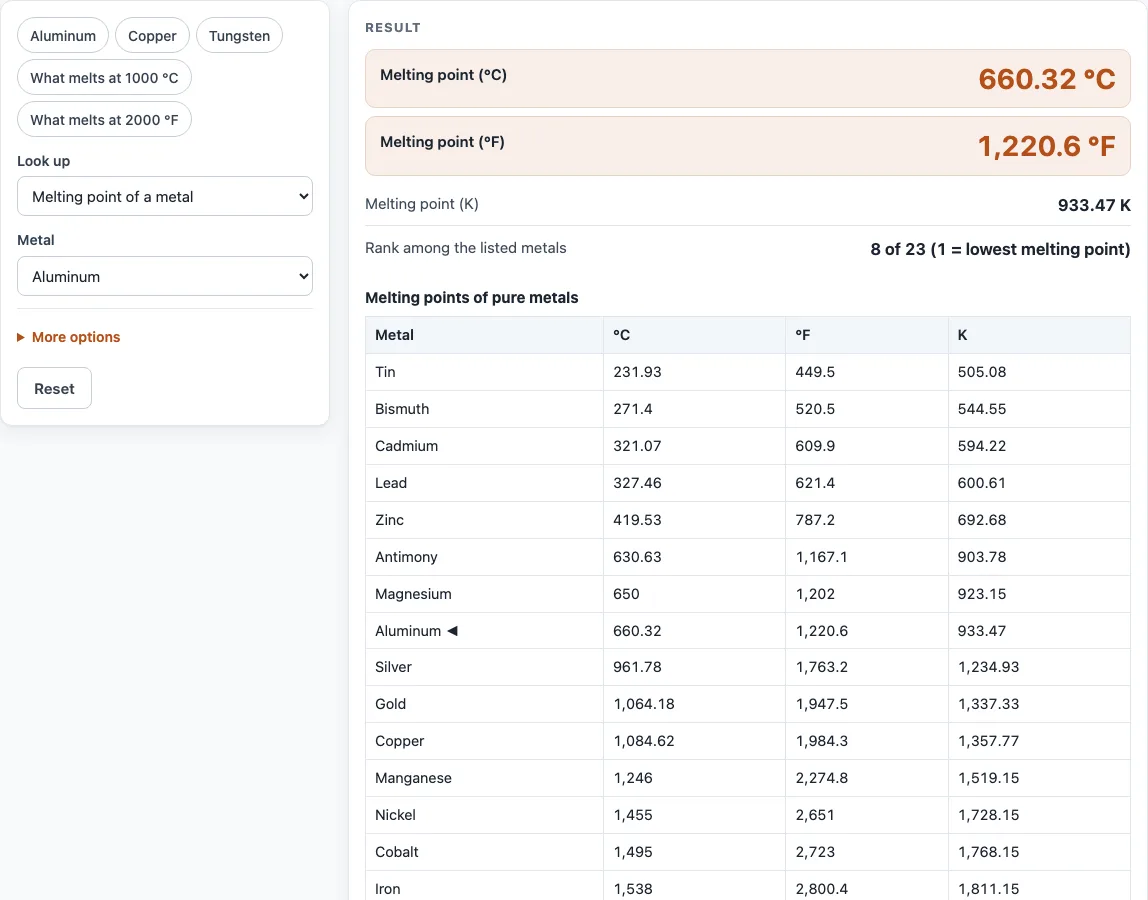
The Metal Melting Point Chart lists the standard melting points of 23 pure metals in °C, °F and K, and shows which of them are molten at a temperature you enter. It is a free, browser-based chart of metal melting points, so you can use it as a melting point of metals table or a melting temperature of metals chart without signing up. Each metal shows its rank among the 23, so you can see at a glance where aluminium, copper, iron or tungsten sit relative to each other.
Use the chart to check one metal, to compare metals, or to find out which ones are still solid at a given heat. Alloys such as steel, brass, bronze and solder are not in the list, because they melt over a range; the alloy maker’s data gives those figures. The results update as you type, and the tool works on a phone.
How to use the Metal Melting Point Chart
- Choose a mode. Pick the single-metal mode to see one metal’s melting point, or the temperature mode to see which metals are molten at a temperature you choose.
- In single-metal mode, enter or select the metal you need. The melting point appears in °C, °F and K, with the metal’s rank among the 23 listed metals.
- In temperature mode, type the temperature and choose its unit: °C, °F or K.
- Read the results. They update as you type, so you can change the number and watch the answer change.
- Open “How it was calculated” to see the formula and each step using your numbers.
- Sort the table by melting point, from low to high or high to low, or by name, to scan the list in the order you need.
Copy result copies the result lines with a link. Copy link copies the page address, which stores every input (?s=…), so opening it later restores the same calculation. Print / save as PDF prints the inputs, results, calculation steps and the date, which is useful for shop paperwork.
The presets jump to aluminium, copper and tungsten, and to the 1000 °C and 2000 °F comparisons.
What is the melting point of aluminum?
Aluminium (also spelled aluminum) melts at 660.32 °C, which is 1,220.6 °F or 933.47 K. It is one of the lower-melting metals in the list, well below copper and iron, so it reaches the liquid state at a much lower temperature than either.
What is the melting point of steel?
Steel does not have one melting point, because it is an alloy that melts over a range between its solidus and liquidus temperatures. The chart does not list steel, so take the range from the alloy maker’s data for the grade you are working with. Do not use the value for pure iron, which is 1538 °C, as the melting point of steel, since the alloy’s range depends on its composition.
What is the melting point of copper?
Copper melts at 1,084.62 °C, which is 1,984.3 °F or 1,357.77 K. This is a reference value for pure copper. It sits just above gold at 1064.18 °C and below iron at 1538 °C in the list.
Which metal has the highest melting point?
Tungsten has the highest melting point of the 23 listed metals, at 3,422 °C. That is 6,191.6 °F or 3,695.15 K. Its high melting point is why it is used for TIG electrodes. Tantalum, at 3,017 °C, is the next highest in the list.
What metals melt at 1000 degrees?
At 1000 °C, 9 of the 23 listed metals are molten: tin, bismuth, cadmium, lead, zinc, magnesium, antimony, aluminium and silver. Gold, copper, nickel and metals above them are still solid at that temperature.
The same check at 1000 °F gives a different answer. 1000 °F is about 537.8 °C, so only 5 of the 23 metals are molten: tin, bismuth, cadmium, lead and zinc. Always check whether your temperature is in °C or °F before you read the result.
Sources
Checked October 2026:
- Wikipedia, Melting points of the elements (data page) for all 23 pure metals (CRC Handbook values); °F = °C × 9/5 + 32, K = °C + 273.15
For estimation; verify critical designs against the applicable standard.
Worked examples
| Input | Result |
|---|---|
| Aluminum | 660.32 °C = 1,220.6 °F = 933.47 K |
| Copper | 1,084.62 °C = 1,984.3 °F = 1,357.77 K |
| Tungsten | 3,422 °C = 6,191.6 °F = 3,695.15 K |
| 1000 °C | 9 of 23 listed metals molten |
| 1000 °F | 5 of 23 listed metals molten |
Calculated by the tool above with these values.
Frequently asked questions
Which metal has the lowest melting point?
Tin has the lowest melting point of the 23 listed metals, at 231.93 °C (449.5 °F, 505.08 K). Bismuth is next at 271.4 °C.
How do I convert a melting point between °C, °F and K?
Use °F = °C × 9/5 + 32 for Fahrenheit and K = °C + 273.15 for kelvin. For example, 0 °C equals 32 °F and 273.15 K.
Is the chart free to use for commercial work?
Yes. It is free, and the results may be used in commercial work such as quotes, welding procedure planning, shop paperwork and reports, without attribution.
Does the tool work on a phone, and is my data uploaded?
It works on a phone. Everything runs in the browser, and nothing you enter is uploaded.
Can the chart tell me which metals are still solid at a temperature I enter?
Yes. In temperature mode, the results show which metals are molten and which are still solid, along with the next metal to melt.
What is the melting point of gold and silver?
Gold melts at 1,064.18 °C (1,947.5 °F) and silver at 961.78 °C (1,763.2 °F).
What is the melting point of titanium?
Titanium melts at 1,668 °C (3,034.4 °F), higher than iron (1,538 °C) and nickel (1,455 °C).
Is the melting point the same as the welding temperature?
No. The arc and the weld pool are much hotter than the melting point; the table only shows when each pure metal turns liquid.
Related tools
- Heat input calculator: use it to work out the heat input for a welding procedure once you know the material’s melting behaviour.
- Carbon equivalent calculator: use it to estimate carbon equivalent when you are judging a steel’s weldability.
- TIG cup size chart: use it to pick the right gas cup size for your TIG torch.
- Welding rod chart: use it to match a filler rod to the base metal you are joining.
- Welding shade chart: use it to choose the correct filter shade for your welding process.
- All welding calculators: use it to browse every calculator and chart on the site.