MIG Gas Flow Rate Chart and Calculator
Pick the metal and transfer mode to see the shielding gas flow in CFH and L/min, and how long an argon cylinder lasts at that flow.
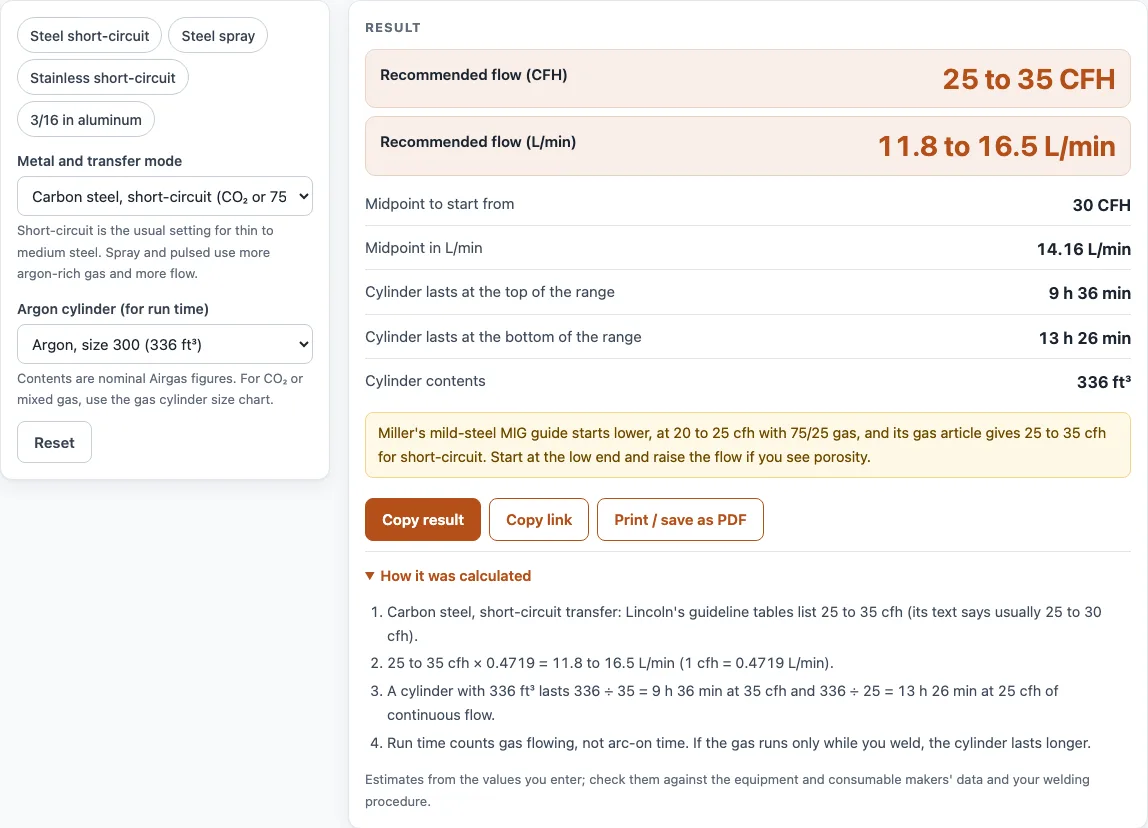
This MIG gas flow rate chart and calculator tells you how much shielding gas to set on your flowmeter. Choose the metal and the transfer mode, such as carbon steel with short-circuit transfer or aluminum of a given thickness, and the tool returns a recommended range in cubic feet per hour (CFH) and in litres per minute. It also shows how long an argon cylinder of your size lasts at the bottom and the top of that range.
The flows come from Lincoln Electric’s GMAW guide and Miller Electric’s MIG articles, and the page names the source of each range. It runs in your browser, is free, needs no sign-up, and nothing you enter is uploaded. Use it as a starting point at the machine, then adjust for your torch, nozzle and draughts.
How to use the MIG gas flow rate calculator
- Under Metal and transfer mode, pick the setup that matches your job: carbon steel short-circuit, carbon steel axial spray, carbon steel pulsed spray, stainless short-circuit, stainless spray, or aluminum.
- For aluminum, choose the plate thickness. The flow rises with thickness, from 25 CFH at 1/16 in to 60 CFH at 3/4 in.
- Choose your argon cylinder size to see the run time.
- Read the recommended flow in CFH and L/min. The midpoint is a sensible first setting. For aluminum, a second line shows the highest flow Lincoln lists at that thickness for other joints and passes.
- Set that flow on the flowmeter of your regulator while the gas is running, then weld a test piece and look for porosity, which shows as small holes or pits in the bead. If you see it, check the hose and nozzle for leaks and drafts before you raise the flow, and raise the flow in small steps only if the weld is still porous.
- Open How it was calculated to see the source range, the unit conversion and the run time worked out.
Preset buttons load typical cases, and Reset returns to the starting example. Copy result copies the result lines with a link, Copy link saves your inputs in the page address, and Print / save as PDF gives a one-page record.
What gas flow rate should I use for MIG welding?
For carbon steel with short-circuit transfer, Lincoln’s guideline tables list 25 to 35 CFH, and its text says the flow is usually 25 to 30 CFH. Miller’s article on gas for DIY MIG welding recommends 25 to 35 CFH for short-circuit welding, while its mild-steel guide starts lower, at 20 to 25 CFH with 75% argon / 25% CO₂. For axial spray transfer on steel with 90% argon / 10% CO₂, Lincoln lists 35 to 45 CFH, and 30 to 40 CFH for pulsed spray.
Stainless steel short-circuit welding with a helium tri-mix uses 15 to 20 CFH in Lincoln’s table, and spray transfer with 98% argon / 2% oxygen uses 25 to 40 CFH. Aluminum needs more argon as the plate gets thicker: 25 CFH at 1/16 in, 30 CFH at 3/32 and 1/8 in, 40 CFH at 1/4 in, 50 CFH at 3/8 in and 60 CFH at 3/4 in for typical single-pass joints.
Wire larger than 1/16 in and helium mixes need a higher flow than these ranges, according to Lincoln.
How is MIG gas pressure different from flow rate?
The setting that matters is the flow, not the pressure. Lincoln describes a flowmeter regulator with two readings: one gauge shows the pressure inside the cylinder, so you can see how much gas remains, and the other shows the flow rate leaving the cylinder in CFH or L/min. Set the flow with the flowmeter while the gas is running, and treat the cylinder gauge as a fuel gauge.
What happens if the flow is too low or too high?
Miller says too little flow lets air into the puddle and causes porosity, while too much flow wastes gas and can create turbulence that also pulls in air. Start near the midpoint, then change the flow in small steps until the weld is clean. Outdoors, use a wind block or tent, because moving air blows the shielding gas away.
How long will a cylinder last at that flow?
Run time is the gas in the cylinder divided by the flow. A size 300 argon cylinder holds about 336 ft³, so at 25 CFH it lasts 13.44 hours, which is 13 h 26 min, and at 35 CFH it lasts 9.6 hours, which is 9 h 36 min. This counts the hours the gas is flowing. Because MIG gas flows only while the trigger is pulled, the cylinder lasts longer in a shop day.
Sources
Read October 2026:
- Lincoln Electric, Gas Metal Arc Welding Guide: shielding gas regulation text and the welding guideline tables for carbon steel, stainless steel and aluminum
- Miller Electric, Understanding the Basics of MIG Welding for Mild Steel: 20 to 25 CFH
- Miller Electric, What Type of Gas Is Best for MIG Welding in DIY Applications?: 25 to 35 CFH for short-circuit, effects of low and high flow, wind block outdoors
- Cylinder contents: nominal Airgas figures, as on the gas cylinder size chart
The ranges are starting points. Follow your wire maker’s and machine maker’s data for a qualified procedure.
Worked examples
| Input | Result |
|---|---|
| Carbon steel, short-circuit (CO₂ or 75/25 Ar-CO₂) | 25 to 35 CFH, 11.8 to 16.5 L/min |
| Carbon steel, axial spray (90/10 Ar-CO₂) | 35 to 45 CFH, 16.5 to 21.2 L/min |
| Stainless steel, short-circuit (helium tri-mix) | 15 to 20 CFH, 7.08 to 9.44 L/min |
| Aluminum (argon), by plate thickness, 3/16 in | 30 to 35 CFH, 14.2 to 16.5 L/min |
Calculated by the tool above with these values.
Frequently asked questions
What is the correct gas flow for MIG welding mild steel?
Start at 20 to 25 CFH with 75% argon / 25% CO₂ for light work, following Miller’s mild-steel guide, and use 25 to 35 CFH for short-circuit welding with a larger nozzle or a draught, following Miller’s gas article and Lincoln’s tables. If you see porosity, raise the flow in small steps.
How many CFH should I set for MIG welding aluminum?
Aluminum with pure argon starts at 25 CFH on 1/16 in sheet and rises to 40 CFH on 1/4 in plate and 50 CFH on 3/8 in, based on Lincoln’s guideline tables. Lincoln lists higher flows, up to 60 or 85 CFH, for some thicker and multi-pass joints.
What PSI should I set the MIG gas regulator to?
You set a flow, not a pressure. A flowmeter regulator shows the cylinder pressure on one gauge and the gas flow on the other, so adjust the flow knob to the CFH you want while the gas is running, and read the cylinder gauge only to see how much gas is left.
Does MIG gas flow change with the nozzle or the wire?
Yes. Lincoln says electrodes larger than 1/16 in need a higher flow, and so do helium mixes. The sources used here give no separate numbers for nozzle size, so use the ranges as a starting point and adjust at the machine.
Is the same flow right for flux-cored wire?
Self-shielded flux-cored wire needs no gas. Gas-shielded flux-cored wire has its own flow range printed on the wire maker’s data sheet, so this tool does not cover it.
Can I use the results in a welding procedure?
Use them as starting values. A qualified procedure comes from your own tests and the maker’s data, and this page does not certify any weld.
Related tools
- Welding gas bottle size chart: use it for cylinder contents and run time with CO₂, oxygen and acetylene as well as argon.
- MIG welding settings chart: use it to find wire feed speed, voltage and amps for your plate thickness.
- MIG wire size chart: use it to pick a wire diameter for your amperage.
- TIG cup size chart: use it to match the cup size and argon flow for TIG work.
- Welding cost calculator: use it to include gas cost in a job estimate.
- All welding calculators: use it to browse every calculator on the site.