MIG Welding Settings Chart
Enter the metal thickness and wire size to get a starting amperage, wire feed speed and voltage for MIG welding steel.
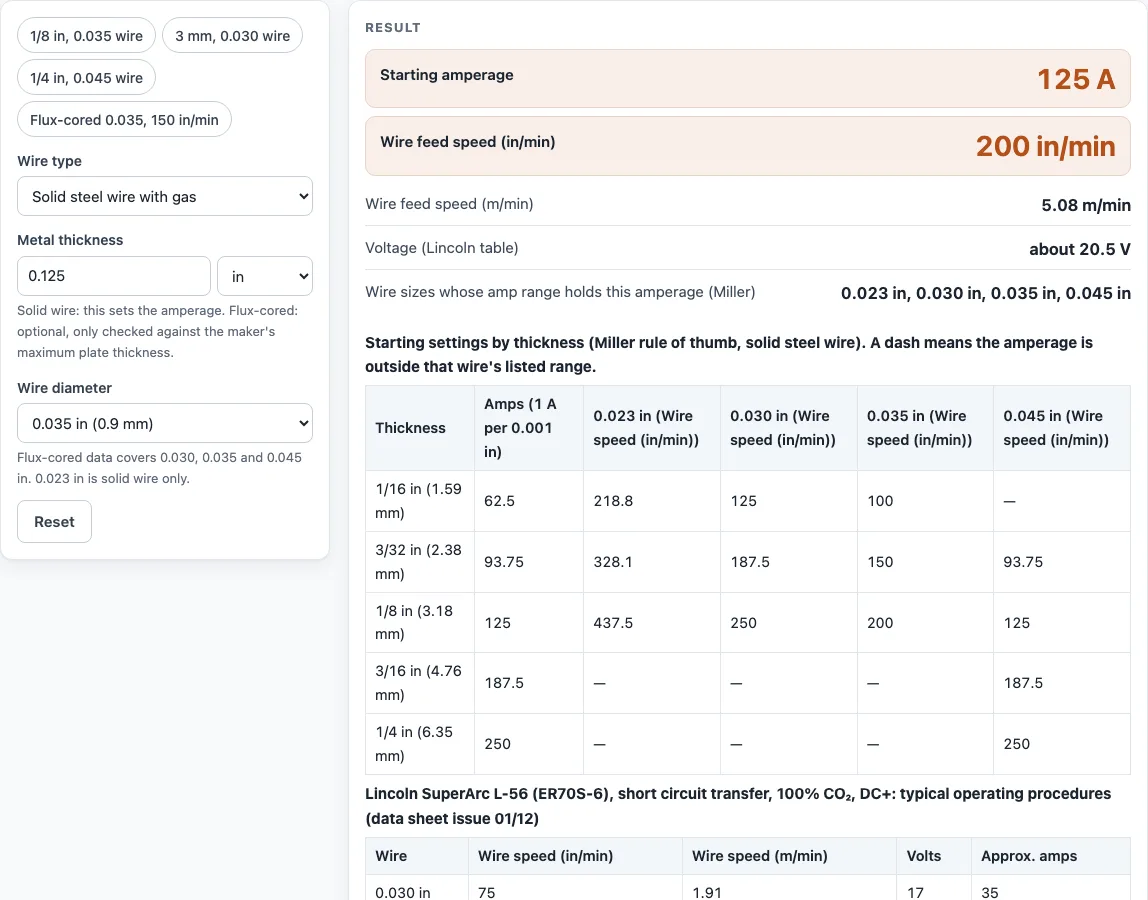
How to use the MIG welding settings calculator
- Choose the wire type: solid steel wire with gas, or self-shielded flux-cored wire.
- For solid wire, enter the metal thickness and pick inches or millimeters as the unit.
- Choose the wire diameter: 0.023, 0.030, 0.035 or 0.045 in.
- Read the amperage, the wire feed speed in both in/min and m/min, and the voltage. If the amperage is outside the wire’s listed range, a warning appears.
- For flux-cored wire, choose 0.030, 0.035 or 0.045 in, then enter a wire feed speed in in/min or m/min. Read the approximate amps and voltage. A warning appears above 5/16 in plate thickness.
- Look at the thickness table from 1/16 to 1/4 in to compare the four wire sizes.
- Open “How it was calculated” to see the formula and each step with your numbers.
- Try the presets (1/8 in with 0.035 wire, 3 mm with 0.030 wire, 1/4 in with 0.045 wire, or flux-cored 0.035 at 150 in/min) to see typical cases.
Results update as you type, so you can change one input at a time and watch the output. Copy result copies the result lines with a link. Copy link copies the page address, which stores every input (?s=…), so opening it later restores the same calculation. Print / save as PDF prints the inputs, results, calculation steps and the date.
What are the MIG welding settings for a given metal thickness?
The calculator starts with Miller Electric’s rule of thumb: each 0.001 in of material thickness needs about 1 amp of output. Wire feed speed then comes from the amperage multiplied by a factor for the wire: 3.5 in/min per amp for 0.023 in, 2 for 0.030 in, 1.6 for 0.035 in and 1 for 0.045 in.
Miller lists an amperage range for each wire: 30 to 130 A for 0.023 in, 40 to 145 A for 0.030 in, 50 to 180 A for 0.035 in and 75 to 250 A for 0.045 in. The tool warns when the amperage falls outside the range for the wire you picked.
Voltage is not part of Miller’s rule. The calculator takes it from Lincoln Electric’s SuperArc L-56 data sheet for short circuit transfer with 100% CO2, interpolating between the listed wire speeds. It shows no voltage outside those rows. Lincoln also says that with 75% argon / 25% CO2 in short circuit mode, you should reduce the voltage by 1 to 2 volts. Together, the amps, wire speed and volts work like a MIG voltage wire speed chart for your thickness, and the table under the result is a printable MIG setting chart.
Miller’s rule and Lincoln’s table come from different makers and do not give the same current at one wire speed. Treat the result as a starting point and tune the arc from there. For example, 3 mm (0.118 in) steel with 0.030 in wire gives 118.1 A and 236.2 in/min (6 m/min).
How many amps do I need for 1/8 in steel with a MIG welder?
For 1/8 in (0.125 in) steel, the rule gives about 125 amps. Wire feed speed then depends on the wire size, because each diameter has its own factor:
- 0.023 in wire: 437.5 in/min
- 0.030 in wire: 250 in/min
- 0.035 in wire: 200 in/min
- 0.045 in wire: 125 in/min
For example, 0.125 in steel with 0.035 in wire gives 125 A and 200 in/min (5.08 m/min). Miller’s page this rule comes from is written for steel with solid wire. The calculator has no aluminum or stainless settings, because no public maker chart was found to check them against.
Sources
Checked October 2026:
- Miller Electric, MIG Welding: Setting the Correct Parameters: 1 A per 0.001 in of thickness, amperage range and inches-per-minute-per-amp factor for each wire (steel, solid wire)
- Lincoln Electric SuperArc L-56 (ER70S-6) data sheet, typical operating procedures, short circuit transfer with 100% CO2 (PDF): voltage, and the 1–2 V reduction for 75% Ar / 25% CO2
- Lincoln Electric Innershield NR-211-MP (E71T-11) data sheet, typical operating procedures (PDF): flux-cored wire feed speed, amps, volts and the 5/16 in maximum plate
For estimation; verify critical designs against the applicable standard.
Worked examples
| Input | Result |
|---|---|
| 0.125 in, 0.035 in solid wire | 125 A, 200 in/min (5.08 m/min) |
| 3 mm, 0.030 in solid wire | 118.1 A, 236.2 in/min (6 m/min) |
| 0.25 in, 0.045 in solid wire | 250 A, 250 in/min (6.35 m/min) |
| 0.035 in flux-cored at 150 in/min | about 130 A, about 17 to 18 V |
| 0.030 in flux-cored at 4 m/min | about 82.99 A, about 14 to 15 V |
Calculated by the tool above with these values.
Frequently asked questions
What are flux core wire speed and voltage settings?
In flux-cored mode, enter a wire feed speed for 0.030, 0.035 or 0.045 in wire. The calculator reads approximate amps and voltage from Lincoln’s Innershield NR-211-MP table (E71T-11, self-shielded, DC electrode negative). For example, 0.035 in wire at 150 in/min gives about 130 A and about 17 to 18 V.
What voltage goes with a given MIG wire speed?
This is the question a MIG welding voltage and wire speed chart answers.
The voltage comes from Lincoln’s SuperArc L-56 table for short circuit transfer with 100% CO2. The calculator interpolates between the listed wire speeds and shows no voltage outside those rows. If you use 75% argon / 25% CO2, reduce the voltage by 1 to 2 volts, as Lincoln advises.
How do I get wire speed from amperage for 0.030, 0.035 or 0.045 wire?
Multiply the amps by the factor for your wire: 2 for 0.030 in, 1.6 for 0.035 in and 1 for 0.045 in, in in/min per amp. For example, 250 A with 0.045 in wire gives 250 in/min (6.35 m/min).
What amperage range is safe for each MIG wire?
Use the range Miller lists for your wire: 30 to 130 A for 0.023 in, 40 to 145 A for 0.030 in, 50 to 180 A for 0.035 in and 75 to 250 A for 0.045 in. The calculator warns you when the amperage is outside that range.
Is there a MIG settings chart for aluminum?
This page does not include one. The calculator covers steel with solid wire and flux-cored wire only. Use the chart from your wire and welding machine maker for aluminum settings.
Can I use these results as final settings?
No. The results are starting settings. Miller’s rule and Lincoln’s table come from different makers and do not give the same current at one wire speed. Check the numbers against your wire maker’s data and your welding procedure, then tune the arc.
Related tools
- MIG wire size chart: use it to compare wire diameters before you pick one for your job.
- Welding travel speed calculator: use it to estimate how fast to move the torch once your settings are chosen.
- Heat input calculator: use it to estimate heat input from your amps, volts and travel speed.
- Welding gas bottle size chart: use it to check how long a shielding gas cylinder will last.
- Stick welding amperage chart: use it when you are welding with stick instead of MIG.
- All welding calculators: use it to browse every calculator on the site.