Stick Welding Amperage Chart
Pick an electrode class and rod diameter to see the maker's amperage range and polarity for stick (SMAW) welding.
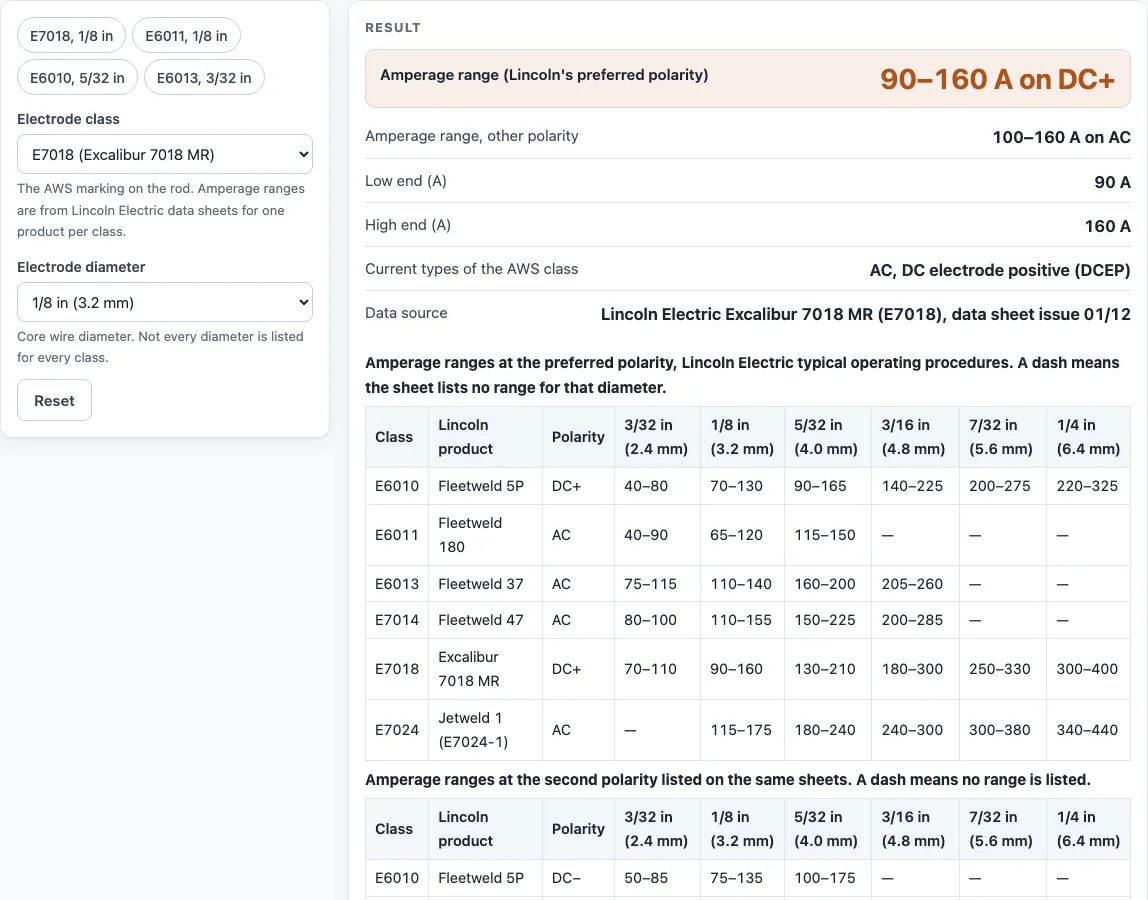
This stick welding amperage chart shows the typical amperage range for six common stick electrode classes (E6010, E6011, E6013, E7014, E7018 and E7024) at diameters from 3/32 to 1/4 inch (2.4 to 6.4 mm). Pick a class and a diameter, and the amp range appears with the preferred polarity first and the second polarity beside it.
Every range comes from Lincoln Electric data sheets, so each number is the maker’s typical operating range for that product. Rods from other makers in the same class can run differently. Use it as a stick welder settings chart or SMAW amperage chart for the rod in your hand. The tool is free, runs in your browser with no sign-up, and works on a phone.
How to use the Stick Welding Amperage Chart
- Choose the electrode class, such as E7018 or E6011. Results update as you change it.
- Choose the electrode diameter, from 3/32 to 1/4 inch (2.4 to 6.4 mm).
- Read the main range. This is the polarity Lincoln lists first on its sheet, shown in amps.
- Check the second polarity shown beside it. If a diameter is not listed for a class, the tool says so instead of guessing.
- Read any note. A note appears when the maker’s polarity list goes beyond the class designation, as it does for E6010.
- Open “How it was calculated” to see the formula and each step with your numbers.
Copy result copies the result lines with a link. Copy link copies the page address, which stores every input (the ?s= part), so opening it later restores the same calculation. Print / save as PDF prints the inputs, results, calculation steps and the date, which is useful for shop paperwork.
The two tables under the result list every class and diameter, one for the preferred polarity and one for the second polarity, so you can compare rods of different classes side by side or print the whole stick welding chart for the shop wall.
What amperage should I use for a 1/8 in E7018 rod?
Start with 90 to 160 A on DC+. That is the range the chart shows first for Lincoln’s Excalibur 7018 MR at 1/8 inch, because it is the polarity Lincoln prefers on that sheet.
The second polarity is AC, at 100 to 160 A. Use the range that matches your machine and your class rules. Both ranges are typical values, so check your rod’s packaging and your own test beads before welding a production joint.
What is the stick welder amp setting for 6010 / 6011 / 6013?
There is no single amp setting for these classes. Each class has its own range, and the range changes with diameter.
For E6010, Lincoln’s Fleetweld 5P sheet gives 90 to 165 A on DC+ at 5/32 inch. For E6011, Fleetweld 180 covers diameters up to 5/32 inch. For E6013, Fleetweld 37 covers diameters up to 3/16 inch, and 3/16 inch runs 205 to 260 A on AC.
What amps does 3/32 stick welding rod need?
The answer depends on the class. For an E6011 rod at 3/32 inch, the chart gives 40 to 90 A on AC.
Because the chart lists diameters from 3/32 inch upward, 3/32 is the smallest size it covers. Check the range for your exact class, since two classes at the same diameter can differ.
What does the chart’s “preferred polarity” mean?
Preferred polarity is the current direction the maker lists first on its data sheet. The tool shows that range as the main answer, with the second polarity beside it.
Polarity describes how the current flows. DC+ (electrode positive) and DC- (electrode negative) are direct current, and AC switches direction. The AWS class number decides which current types a rod is designed for. E6010 is classified for DC electrode positive only, but Lincoln’s sheet also gives a DC- range, so the tool shows a note in that case.
Sources
Checked October 2026 (Lincoln Electric data sheets, typical operating procedures; the preferred polarity is listed first):
- E6010: Fleetweld 5P · E6011: Fleetweld 180 · E6013: Fleetweld 37
- E7014: Fleetweld 47 · E7018: Excalibur 7018 MR · E7024: Jetweld 1 (E7024-1)
- Current types allowed by each class: AWS A5.1 classification digits, as on the welding rod chart
For estimation; verify critical designs against the applicable standard.
Worked examples
| Input | Result |
|---|---|
| E7018, 1/8 in | 90–160 A on DC+ |
| E6010, 5/32 in | 90–165 A on DC+ |
| E6011, 3/32 in | 40–90 A on AC |
| E6013, 3/16 in | 205–260 A on AC |
| E7024, 1/4 in | 340–440 A on AC |
Calculated by the tool above with these values.
Frequently asked questions
Can I run a 7018 rod on AC?
Yes, if the rod’s classification allows it. The chart lists AC as the second polarity for Lincoln’s Excalibur 7018 MR, at 100 to 160 A for 1/8 inch. The tool shows which current types the AWS class number allows, so check that line before you switch.
Why does my chart show no amps for a 3/16 6011 rod?
Lincoln’s Fleetweld 180 sheet for E6011 stops at 5/32 inch, so there is no 3/16 inch range to show. The tool says so instead of guessing a number.
Does the chart give amps from plate thickness?
No. This tool has no amperage-from-plate-thickness advice or rule of thumb, because no manufacturer page for one was found. It only shows the maker’s typical range for each class and diameter.
Do other makers’ rods use the same amps?
Not exactly. The ranges here are Lincoln’s typical operating ranges for one product in each class. Another maker’s E7018 can list a different range, so check the box or data sheet of the rod you actually use.
What do the letters and numbers on a rod mean?
The welding rod chart on this site explains what each part of the rod classification means. Use it to decode a rod label before you read the amperage range.
Related tools
- Welding rod chart: use it to decode the letters and numbers on a rod label before you check amps.
- MIG welding settings chart: use it when you are setting up a MIG process instead of stick.
- TIG amperage chart: use it when you need amperage ranges for TIG welding.
- Welding cable size chart: use it to check cable sizing for your welding leads.
- Welding shade chart: use it to pick a lens shade for your welding process.
- All welding calculators: use it to browse every calculator on the site.