Stitch Weld Calculator
Enter the joint length, weld length and pitch to get how many stitch welds fit, the exact pitch and where each weld starts and ends.
How to use the Stitch weld calculator
- Choose the mode. Enter a number of welds to get the exact pitch, or enter a pitch to get the number of welds.
- Enter the joint length, L, in the unit you are working in (inches, mm or m).
- Enter the weld length, l, which is the length of each individual weld.
- Enter the pitch, p, measured centre to centre. For a symbol marked 2-6, the weld length is 2 and the pitch is 6.
- Set whether there are welds at both ends of the joint. Turn this on if the joint starts and finishes with a weld, and leave it off if the run stops short of the ends.
- Pick the layout: one side, both sides chain, or both sides staggered.
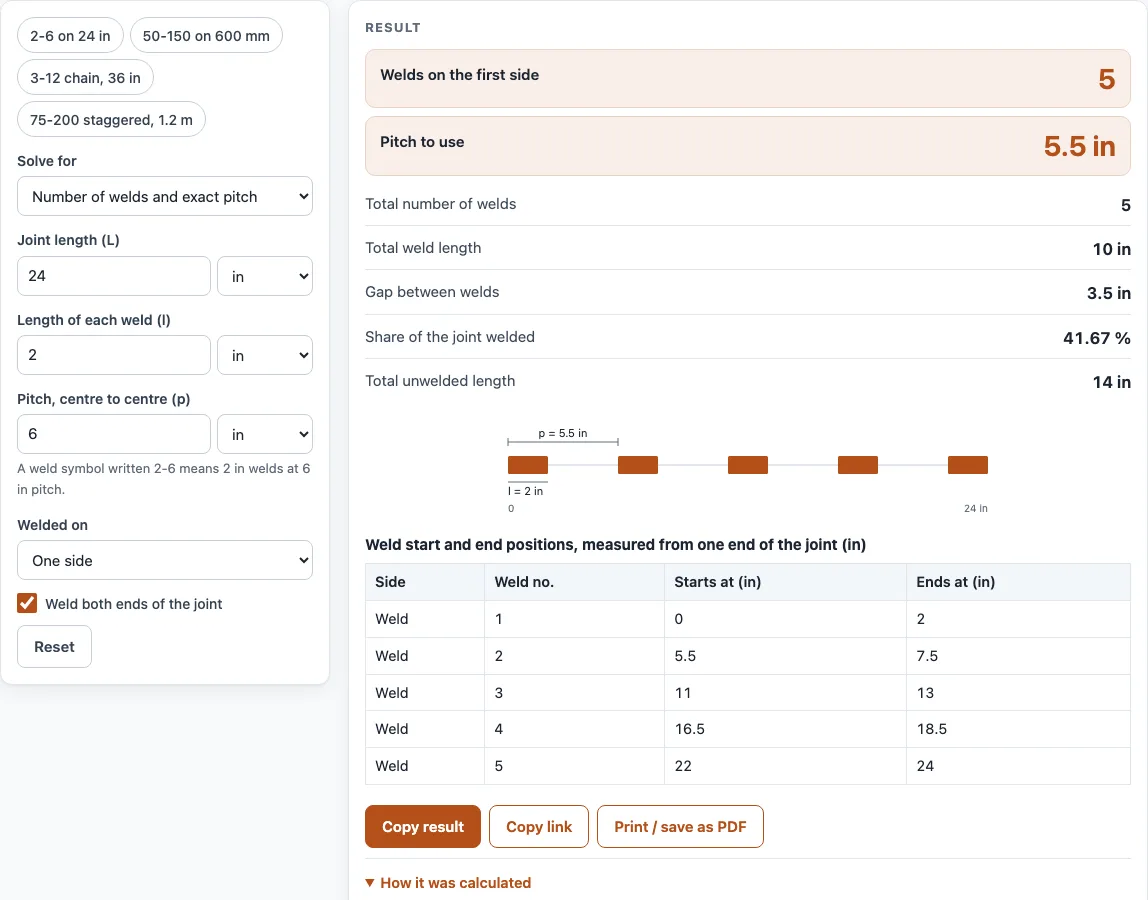
- Read the results: welds on the first side, total welds, pitch to use, total weld length, gap between welds, share of the joint welded, and unwelded length. Check the start and end positions in the table, and look at the strip, which shows the welds along the joint.
Results update as you type, so change one value at a time to see its effect. The “How it was calculated” section lists the formula and each step with your numbers. Copy result copies the result lines with a link. Copy link copies the page address, which stores every input, so opening it later restores the same calculation. Print / save as PDF prints the inputs, results, calculation steps and the date.
What does 2-6 mean on a stitch weld?
On a welding symbol, 2-6 means each weld is 2 units long, and the welds are repeated every 6 units. For example, 2-6 in on a drawing means 2 in welds at 6 in pitch. The gap between welds is the pitch minus the weld length, so here it is 4 in.
Is stitch weld pitch measured centre to centre?
Yes. The pitch is the distance from the centre of one weld to the centre of the next. Because of this, the gap between welds is always the pitch minus the weld length, not the pitch itself.
How do you calculate stitch weld spacing?
With welds at both ends of the joint, the number of welds is n = ceil((L − l) ÷ p) + 1. The pitch is then shortened to fit exactly, p′ = (L − l) ÷ (n − 1), so the actual pitch is never larger than the one on the drawing. Without end welds, the count is n = floor((L − l) ÷ p) + 1 at the given pitch.
For a 24 in joint with 2 in welds at 6 in pitch and end welds, (24 − 2) ÷ 6 = 3.67, which rounds up to 4. Adding 1 gives 5 welds, and the pitch becomes 22 ÷ 4 = 5.5 in. The total welded length is 10 in, or 41.7% of the joint.
How many stitch welds fit on a joint?
The count depends on the joint length, the weld length and the pitch, and whether there are end welds. Use the formula above, rounding up when end welds are included and rounding down when they are not. In a chain layout both sides have the same count, so the total doubles; in a staggered layout the second side, shifted half a pitch, can fit one weld fewer.
For a 36 in joint with 3 in welds at 12 in pitch and end welds, the formula gives 4 welds per side. With both sides, that makes 8 welds in total, with the pitch adjusted to 11 in. Each side welds 33.3% of the joint.
What is the difference between chain and staggered intermittent welds?
In a chain layout, welds on both sides sit directly opposite each other. In a staggered layout, the welds on the second side are shifted by half a pitch, so they fall between the welds on the first side. The pitch is the same on both sides. A staggered second side starts half a pitch in, so with welds at both ends it usually holds one weld fewer than the first side.
Sources
Checked October 2026:
- The Ranger Station, Reading welding symbols: length–pitch notation, pitch measured centre to centre
- Weld counts and spacing are arithmetic on the joint length, weld length and pitch
For estimation; verify critical designs against the applicable standard.
Worked examples
| Input | Result |
|---|---|
| 24 in, weld 2 in, pitch 6 in | 5 welds, pitch 5.5 in, 41.7 % |
| 600 mm, weld 50 mm, pitch 150 mm | 5 welds, pitch 137.5 mm, 41.7 % |
| 36 in, weld 3 in, pitch 12 in | 8 welds, pitch 11 in, 33.3 % |
| 1.2 m, weld 75 mm, pitch 200 mm | 13 welds, pitch 0.1875 m, 40.6 % |
| 1200 mm, weld 75 mm, 6 welds | 6 welds, pitch 225 mm, 37.5 % |
Calculated by the tool above with these values.
Frequently asked questions
Can I use the results on a quote or in shop paperwork?
Yes. Results may be used in commercial work, including quotes, welding procedure planning, shop paperwork and reports, without attribution. Print or save the calculation as a PDF to keep a dated record with the inputs and steps.
Does it work on a phone?
Yes. The calculator runs in the browser and works on a phone, so you can check spacing on site or at the bench.
What does a gap of zero mean?
A gap of zero means the pitch equals the weld length, so the welds join up and form a continuous weld. The calculator shows a warning in this case, so check that a continuous weld is what the drawing calls for.
Is my data sent anywhere?
No. Everything runs in your browser, and nothing you enter is uploaded.
Can I enter the number of welds instead of the pitch?
Yes. Choose ‘Pitch for a number of welds’ and enter how many welds you want; the tool gives the pitch that spreads them from end to end.
Do I need end welds?
Whether the joint needs a weld at each end depends on your drawing or code, so check it. Untick the option to keep the exact drawing pitch from one end.
Related tools
- Welding symbol chart: use it to check what a symbol such as 2-6 or 50-150 means before you enter the values.
- Weld strength calculator: use it to estimate the load a weld can carry once you know its size and length.
- Welding cost calculator: use it to estimate the cost of a welding job, including the amount of weld you are planning.
- Heat input calculator: use it to work out the heat input for a welding procedure.
- All welding calculators: use it to browse every calculator on the site.