TIG Amperage Chart
Choose the metal and enter its thickness to get a starting TIG amp range with tungsten, filler, cup and argon settings.
The TIG amperage chart is a free calculator that suggests a starting amperage range for carbon steel, stainless steel or aluminum, based on the metal thickness you enter in inches or millimeters. It runs in your browser, needs no sign-up, and works on a phone. You get the amp range plus matching tungsten size, filler wire size, gas cup size and argon flow.
Values are drawn from three public Harris Products Group technical sheets (Harris is a Lincoln Electric company). Those sheets cover ER70S-6 steel wire, 316L stainless wire, and 4043 aluminum wire and rod. Treat the output as a starting point rather than final settings, so test on scrap and check your welding procedure.
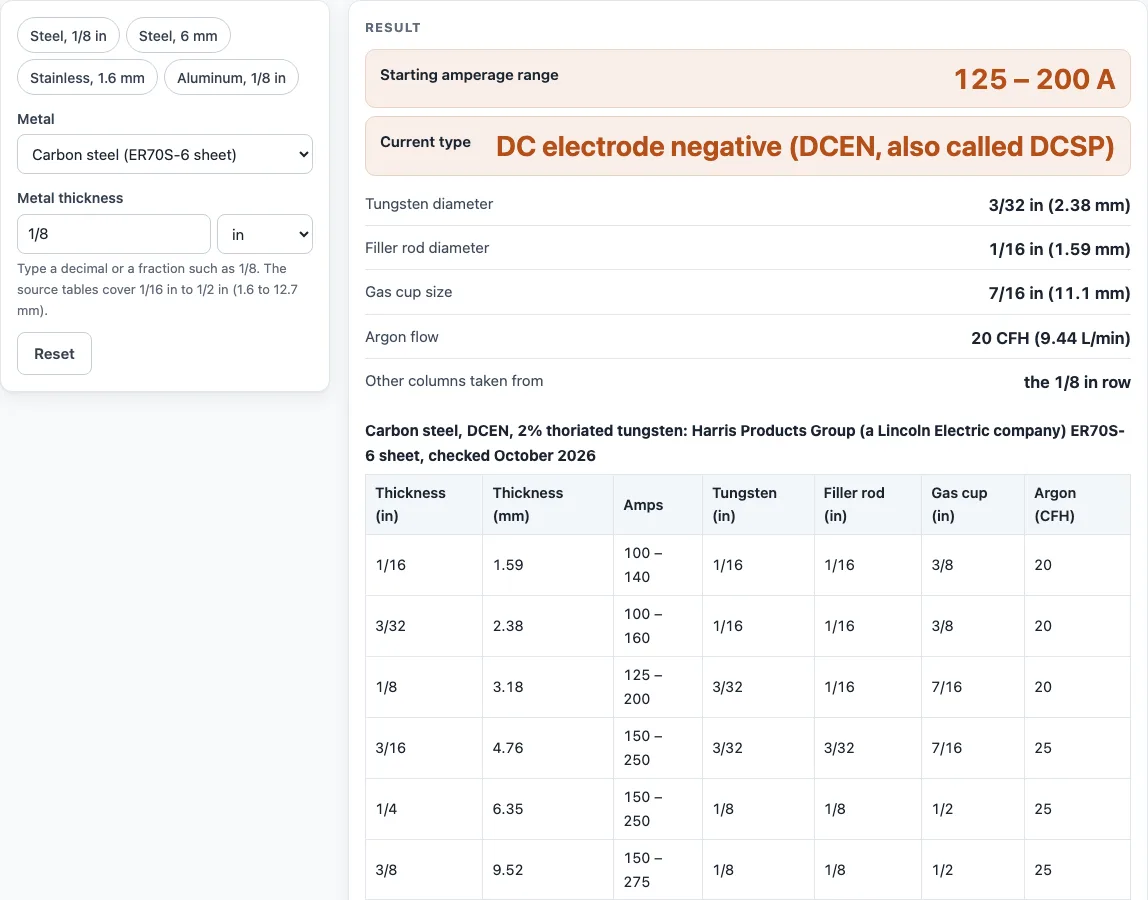
How to use the TIG amperage chart
- Pick your metal: carbon steel, stainless steel or aluminum.
- Enter the metal thickness, then select inches or millimeters. Fractions such as 1/8 work too.
- Read the amp range in the results. Results refresh as you type, so you can change the thickness and watch the range move.
- Confirm the tungsten, filler, cup and argon values listed alongside the amps. Match the polarity shown to your metal type.
- When your thickness lands between two listed sizes, see the note: amp limits are interpolated, while the other columns come from the closest listed size.
- Want to see the work? Open “How it was calculated.” That panel shows the formula and every step with your numbers.
- Run through the four presets (steel 1/8 in, steel 6 mm, stainless 1.6 mm, aluminum 1/8 in) to compare metals, then scroll down to the table for each listed thickness of your chosen metal.
Copy result sends the result lines, with a link, to your clipboard. Copy link grabs the page address, which holds every input (?s=…), so opening it later brings back the same calculation. Print / save as PDF outputs the inputs, results, calculation steps and the date. Keeping a printed sheet beside the welder helps while you test on scrap.
What is a TIG amperage chart, and what amps do I need for 1/8 in steel?
A TIG amperage chart pairs metal thickness with a starting amp range and matching torch settings. For 1/8 in carbon steel, the ER70S-6 sheet lists 125 to 200 A, with a 3/32 in tungsten, 1/16 in filler, a 7/16 in cup and 20 CFH argon.
What amps do I use to TIG weld aluminum, and does it use AC or DC?
Aluminum runs on AC with high frequency in the 4043 sheet, paired with a hemisphere-tip pure or zirconiated tungsten. It needs more amps than steel of the same thickness: 1/8 in aluminum is 125 to 175 A, and 3/8 in is 330 to 380 A. The sheet also specifies a larger tungsten and more argon, such as 35 CFH at 3/8 in.
What polarity is TIG welding steel and stainless (DCEN)?
Steel and stainless steel use DC electrode negative, also known as DCEN or DCSP. Those sheets pair it with 2% thoriated tungsten. Miller’s TIG basics guide gives the same rule: AC for aluminum, DCEN for steel and steel alloys. A 6 mm carbon steel weld runs 150 to 250 A, and a 1.6 mm stainless steel weld runs 80 to 120 A, both on DCEN.
How many amps per thickness for TIG welding?
TIG has no single amps-per-thickness ratio. The tool reads the table rows directly. When your thickness falls between two rows, it interpolates the amp limits in a straight line between them, so the range shifts smoothly with thickness.
What tungsten size and gas flow go with a given thickness?
Tungsten, filler, cup and gas values come from the nearest row in the table, not from interpolation. Only the amp limits are interpolated. As a result, a thickness between two rows can show a calculated amp range, while the tungsten and gas values come from the closest listed size.
Sources
Checked October 2026 (Harris Products Group technical sheets, recommended GTAW parameters):
- ER70S-6 carbon steel: DCSP, 2% thoriated tungsten
- 316L stainless steel: DCSP, 2% thoriated tungsten
- 4043 aluminum: AC with high frequency
- Miller Electric, Guide to TIG welding basics: AC for aluminum, DCEN for steel
For estimation; verify critical designs against the applicable standard.
Worked examples
| Input | Result |
|---|---|
| Carbon steel (ER70S-6 sheet), 1/8 in | 125 – 200 A, DC electrode negative (DCEN, also called DCSP) |
| Carbon steel (ER70S-6 sheet), 6 mm | 150 – 250 A, DC electrode negative (DCEN, also called DCSP) |
| Stainless steel (316L sheet), 1.6 mm | 80 – 120 A, DC electrode negative (DCEN, also called DCSP) |
| Aluminum (4043 sheet), 1/8 in | 125 – 175 A, AC with high frequency |
| Aluminum (4043 sheet), 3/8 in | 330 – 380 A, AC with high frequency |
Calculated by the tool above with these values.
Frequently asked questions
What happens if my thickness is outside 1/16 in to 1/2 in?
The tables cover 1/16 in to 1/2 in (1.6 to 12.7 mm). Outside that range, the tool gives no amperage and tells you so. You will need a different reference for thicker or thinner metal.
Does the tool give separate settings for each joint type?
No. The sheets say the parameters are basic guidelines that vary with joint design, number of passes and other factors. They do not list values per joint type, so this tool does not either.
Is the “1 amp per 0.001 inch” rule used here?
No. Miller publishes that rule of thumb for MIG welding steel with solid wire, not for TIG, so the tool does not use it.
Why does aluminum need more amps than steel?
In the Harris sheets, aluminum of the same thickness is listed at a higher current range on AC than steel on DCEN, for example 330 to 380 A for 3/8 in aluminum against 150 to 275 A for 3/8 in carbon steel. Use the row for your metal rather than converting between them.
Can I use the results in commercial work?
Yes. Results may be used in commercial work, such as quotes, welding procedure planning, shop paperwork and reports, without attribution.
Related tools
- Tungsten electrode chart: this helps when you want to compare tungsten types and sizes against your amp range.
- TIG filler rod chart: choose filler wire or rod sizes for your metal with this one.
- TIG cup size chart: a quick way to match a gas cup size to your tungsten and joint.
- Stick welding amperage chart: handy for checking starting amps on a stick job rather than TIG.
- Heat input calculator: estimate heat input from amps, voltage and travel speed here.
- All welding calculators: browse every calculator and chart on the site in one place.