TIG Cup Size Chart
Convert TIG cup numbers to inside diameters and see how fast the shielding gas leaves the cup at your flow rate.
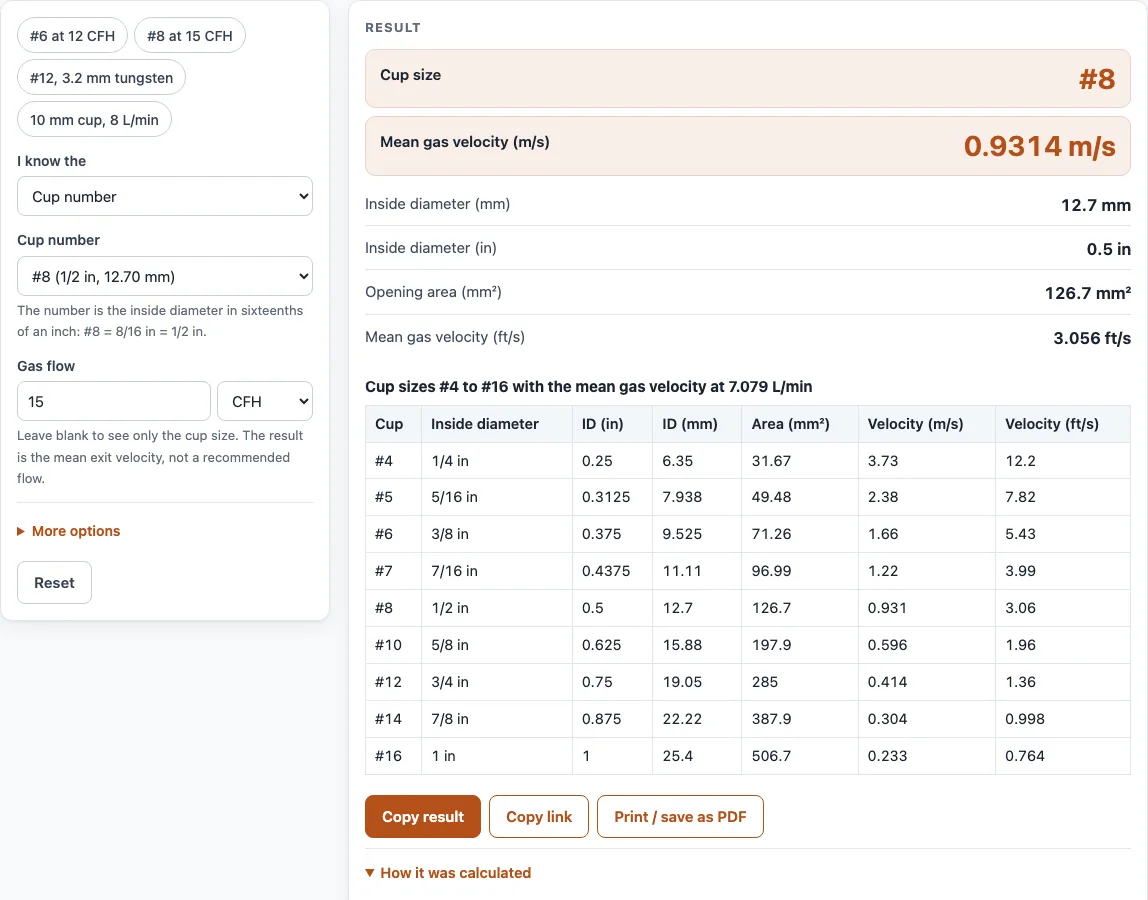
How to use the TIG cup size chart
- Enter your cup. Type a cup number such as 8, or enter the inside diameter in inches or mm.
- Check the equivalent. The tool shows the matching inside diameter and the nearest listed cup.
- Enter your gas flow in CFH, L/min or m³/h, and choose the unit that matches your flowmeter.
- Optional: open More options and enter the tungsten diameter to subtract its area from the cup opening.
- Read the mean gas exit velocity in m/s and ft/s. The cup table shows the same measurement for each standard cup at your flow.
- Open How it was calculated to see the formula and each step with your numbers.
Copy result copies the result lines with a link. Copy link copies the page address, which stores every input (?s=…), so opening it later restores the same calculation. Print / save as PDF prints your inputs, results, calculation steps and the date.
The presets show a #6 at 12 CFH, a #8 at 15 CFH, a #12 with a 3.2 mm tungsten and a 10 mm cup at 8 L/min. The table under the result lists every listed cup at your flow, so you can compare cup sizes at a glance before you change cups.
What do TIG cup numbers mean?
A TIG cup number is the inside diameter of the cup in sixteenths of an inch. For example, #8 means 8/16 in, which is 1/2 in or 12.7 mm. To get inches, divide the number by 16. Common sizes are #4 (1/4 in, 6.4 mm), #6 (3/8 in, 9.5 mm), #8 (1/2 in, 12.7 mm) and #12 (3/4 in, 19.1 mm). These are nominal sizes; check your torch maker’s list, because some cups do not follow the sixteenths rule exactly.
What size is a #8 TIG cup?
A #8 TIG cup has an inside diameter of 1/2 in (12.7 mm). At 15 CFH, the mean gas exit velocity through a #8 cup is 0.93 m/s.
How do you convert TIG cup size to mm?
Multiply the cup number by 25.4 and divide by 16, which is the same as multiplying by 1.5875. Check: #8 × 1.5875 = 12.7 mm, and #6 × 1.5875 = 9.5 mm. To go the other way, divide the millimetre size by 1.5875. A 10 mm cup gives 10 ÷ 1.5875 ≈ 6.3, so it is about #6.3, and the nearest standard cup is #6.
What gas flow for a TIG cup?
The calculator does not recommend a flow. It works out the exit velocity for the flow you enter, so you can check how a flow suits a cup. Get the flow for your job from your torch and gas supplier’s guidance. For reference, 1 CFH = 0.4719 L/min. At 12 CFH, a #6 cup gives 1.32 m/s, and at 20 L/min, a #12 cup gives 1.2 m/s.
Does a bigger cup need more gas?
Not by itself. The same flow through a bigger cup leaves more slowly, because exit velocity = flow ÷ opening area, and the area is π × ID² ÷ 4. Area grows with the square of the diameter, so a larger cup gives slower, wider gas coverage. To keep the same exit velocity in a larger cup, the flow must rise in proportion to the opening area. For example, a #16 (1 in) cup at 25 CFH gives 0.388 m/s, while a #8 cup at 15 CFH gives 0.93 m/s.
How do I compare two cups at the same flow?
Enter the flow once and read the table: each cup’s velocity is the same flow divided by its own opening area. Going from a #6 to a #8 cup almost halves the exit velocity, because the area grows with the square of the diameter (8² ÷ 6² = 1.78).
Sources
Checked October 2026:
- CK Worldwide 2 Series and 3 Series cup listings: #4 1/4 in to #12 3/4 in (cup number = inside diameter in sixteenths of an inch)
- Mean gas velocity = flow ÷ opening area; 1 ft³ = 28.316846592 L (NIST SP 811)
For estimation; verify critical designs against the applicable standard.
Worked examples
| Input | Result |
|---|---|
| Cup #8 | #8: 0.5 in = 12.7 mm inside diameter, mean velocity 0.931 m/s at 15 CFH |
| Cup #6 | #6: 0.375 in = 9.525 mm inside diameter, mean velocity 1.32 m/s at 12 CFH |
| Cup #12 | #12: 0.75 in = 19.05 mm inside diameter, mean velocity 1.2 m/s at 20 L/min |
| Cup ID 10 mm | About #6.3 (nearest standard cup #6): 0.3937 in = 10 mm inside diameter, mean velocity 1.7 m/s at 8 L/min |
| Cup ID 1 in | About #16 (nearest standard cup #12): 1 in = 25.4 mm inside diameter, mean velocity 0.388 m/s at 25 CFH |
Calculated by the tool above with these values.
Frequently asked questions
Can I subtract the tungsten diameter?
Yes. Open More options and enter the tungsten diameter. The tool subtracts the tungsten’s area from the cup opening before it calculates the exit velocity.
Does the tool tell me which cup to use for my amperage?
No. The tool does not recommend a cup size or flow for an amperage or tungsten size. Use the torch and gas supplier’s guidance for those choices.
Can I use the results in paid work?
Yes. Results may be used in commercial work, such as quotes, welding procedure planning, shop paperwork and reports, without attribution.
Does it cost anything or need an account?
No. The tool is free, requires no sign-up, runs in your browser, and works on a phone. Your inputs are not uploaded.
Is cup number the same in metric?
The number is always in sixteenths of an inch, even on metric torches; the tool converts it to mm (#8 = 12.7 mm).
What is a gas lens cup?
A gas lens uses a screen inside the cup body to make the gas flow more even. The cup number still means the inside diameter at the exit, so the size conversion works the same way.
Related tools
- MIG wire size chart: Use it to look up the wire diameter for a MIG welding job.
- Welding shade chart: Use it to find the recommended filter shade for an arc welding process.
- Heat input calculator: Use it to estimate heat input from voltage, current and travel speed.
- Metal melting point chart: Use it to compare the melting points of common metals.
- Welding cable size chart: Use it to choose a cable size for your welding current and cable length.
- All welding calculators: Use it to browse every calculator and chart on the site.