TIG Filler Rod Chart
Pick a base metal to see the usual TIG filler rod, decode a rod classification, or count rods per pound for your rod size.
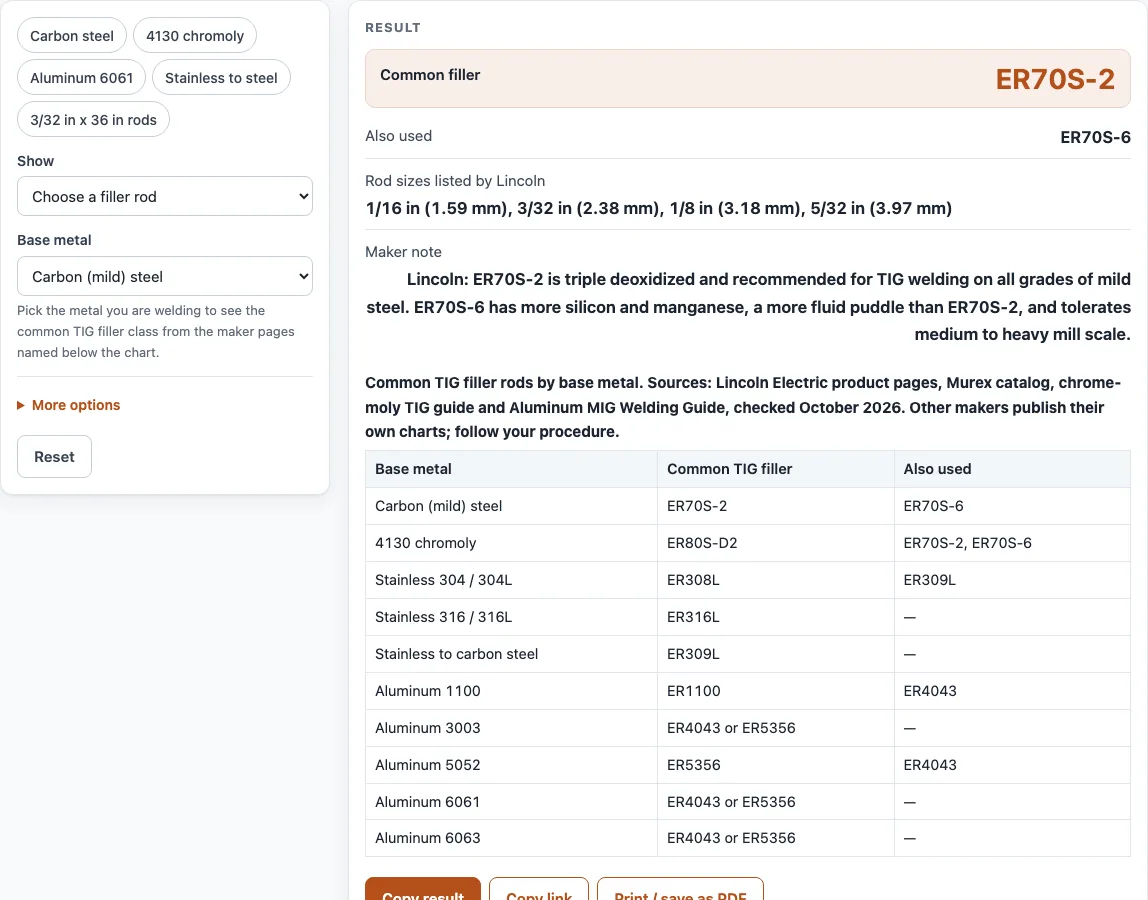
How to use the TIG filler rod chart
The page has three views. Pick the one that matches your task.
- Under “Show”, choose Choose a filler rod, Decode a classification, or Rods per pound or kg.
- For a filler match, select your base metal, such as carbon steel, 4130, 304, 316 or an aluminum alloy. Read the common filler shown for that metal.
- For decoding, enter the rod name, such as ER70S-2. The result splits the name into its parts.
- For a rod count, choose the rod diameter (1/16 to 5/32 in or 1.6 to 4.0 mm) and the rod material, and enter the rod length. Steel 7.85, stainless 8.0 and aluminum 2.70 g/cm³ are used; you can type another density under More options.
- Watch the results update as you type.
- Open “How it was calculated” to see the formula and each step with your numbers.
- Use Copy result to copy the result lines with a link, or Print / save as PDF to save the inputs, results, calculation steps and date.
The presets load common cases: carbon steel, 4130 chromoly, aluminum 6061, stainless to steel, and 3/32 in by 36 in rods.
Copy link copies the page address. The address stores every input (?s=…), so opening it later restores the same calculation. Printing and copying work the same way for any view.
Which TIG filler rod for which metal?
Match the rod to the base metal first. For carbon (mild) steel, Lincoln recommends ER70S-2 for TIG. ER70S-6 has more silicon and manganese, so it tolerates mill scale better and is a sensible choice for rusty or scaled stock.
What filler for 4130, 304 stainless and aluminum 6061?
4130 chromoly takes ER80S-D2, and 304/304L takes ER308L. Aluminum 6061 takes 4043 or 5356. For 4130, Lincoln says ER70S-2 or ER70S-6 are acceptable with slightly lower weld strength. Lincoln does not recommend 4130 filler for roll cages and similar sporting work. Any austenitic stainless filler used on 4130 must be 310 or 312. For 316/316L, use ER316L, which has 2 to 3 % molybdenum.
What sizes do TIG filler rods come in?
Lincoln lists its TIG rods in 1/16, 3/32, 1/8 and 5/32 in, which are 1.6, 2.4, 3.2 and 4.0 mm. Inch sizes are exact fractions, while metric sizes are separate nominal sizes. For example, 1/16 in is 1.5875 mm, but the metric rod is 1.6 mm. ER80S-D2, ER309L and 5356 are listed without the 5/32 in size.
What does ER70S-2 mean?
ER70S-2 is a rod classification. ER means electrode or rod. 70 means 70,000 psi minimum tensile strength. S means solid, and the -2 is a chemistry code. Stainless names follow a different pattern: the number is the alloy (308, 309, 316), L means low carbon, H means high carbon, and Si means extra silicon.
What rod for stainless to mild steel?
Lincoln describes ER309/309L as the rod for dissimilar metals, most often mild steel to stainless. Start with ER309 or ER309L when you join stainless to carbon steel. Confirm the choice against your welding procedure.
4043 or 5356 for 6061?
Either works for 6061, and the choice depends on what the part needs. 4043 is easier to use, flows better and is more crack resistant. 5356 gives stronger, more ductile welds and anodizes with a good color match. Lincoln notes that filler with more than 3 % magnesium, such as 5356, is not suitable for service above 150 °F (65 °C). For other aluminum alloys, Lincoln’s guide pairs 1100 with 1100 or 1188, 3003 with 4043 or 5356, and 5052 usually with 5356.
Sources
Checked October 2026:
- Lincoln Electric product pages: ER70S-2, ER70S-6, ER308/308L, ER309/309L, ER316/316L, SuperGlaze 4043 and 5356 (uses, sizes)
- Lincoln Electric, TIG welding chrome-moly tubing (4130 filler)
- Lincoln Electric, Aluminum MIG Welding Guide C8.100, chapter 3 (PDF) (aluminum filler selection, 150 °F limit for >3 % Mg)
- Red-D-Arc, AWS wire and filler metal designation meanings (decoder)
- Densities as on the MIG wire size chart
For estimation; verify critical designs against the applicable standard.
Worked examples
| Input | Result |
|---|---|
| Carbon (mild) steel | common filler ER70S-2 |
| 4130 chromoly | common filler ER80S-D2 |
| Aluminum 5052 | common filler ER5356 |
| ER308L | parts: ER · 308 · L |
| 1/16 in Carbon steel (7.85 g/cm³) rod, 36 in long | 14.21 g per rod, 31.93 rods per lb, 70.38 rods per kg |
| 2.4 mm Aluminum (2.70 g/cm³) rod, 1000 mm long | 12.21 g per rod, 37.14 rods per lb, 81.87 rods per kg |
Calculated by the tool above with these values.
Frequently asked questions
Can I use the results in quotes or shop paperwork?
Yes. Results may be used in commercial work, such as quotes, welding procedure planning, shop paperwork and reports, without attribution.
Does the tool work on a phone?
Yes. It works on a phone as well as a desktop browser, and nothing you type is uploaded.
Is ER70S-2 or ER70S-6 better for TIG on mild steel?
Lincoln recommends ER70S-2 for TIG on all grades of mild steel. ER70S-6 has more silicon and manganese, so it gives a more fluid puddle and copes better with mill scale on dirty or rusty stock.
How many aluminum rods are in a kilogram?
It depends on the diameter and length. A 2.4 mm aluminum rod 1000 mm long weighs about 12.21 g and gives about 81.87 rods per kg. Enter your own size to get the exact count.
Can I count rods of a different length?
Yes. The diameter is chosen from the eight standard inch and metric sizes, but the rod length is typed in, so 36 in, 1000 mm or any cut length works. The TIG filler rod size chart in the result shows the weight per rod and the count per pound and per kilogram.
Related tools
- TIG amperage chart: Use it to check a starting amperage range before you run a TIG weld.
- Tungsten electrode chart: Use it to choose the tungsten electrode that matches your TIG job.
- MIG wire size chart: Use it when you are choosing wire for MIG instead of TIG.
- Welding rod chart: Use it to match stick electrodes or other welding rods to a base metal.
- Carbon equivalent calculator: Use it to estimate the carbon equivalent of a steel before you weld it.
- All welding calculators: Use it to browse every welding calculator on the site.