Tungsten Electrode Chart
Identify a TIG tungsten by its tip color, or find the current range for a tungsten diameter and the size for your amperage.
This tungsten electrode chart is a free tool that identifies a TIG tungsten from its tip color and shows what it is made of. It also gives the current range for a tungsten diameter, or the diameter that suits a given amperage. Use it when you are choosing an electrode, checking one you already have, or planning a weld.
Everything runs in your browser. There is no sign-up, nothing is uploaded, and it works on a phone. Results update as you type, so you can change the color, diameter, current or amperage and see the new answer straight away.
Each tungsten color stands for an oxide additive, such as lanthanum, cerium, thorium or zirconium. The chart shows the matching AWS and ISO codes. The current ranges come from Lincoln Electric’s tungsten publication E3.30, so treat them as a starting point and check your own electrode’s package.
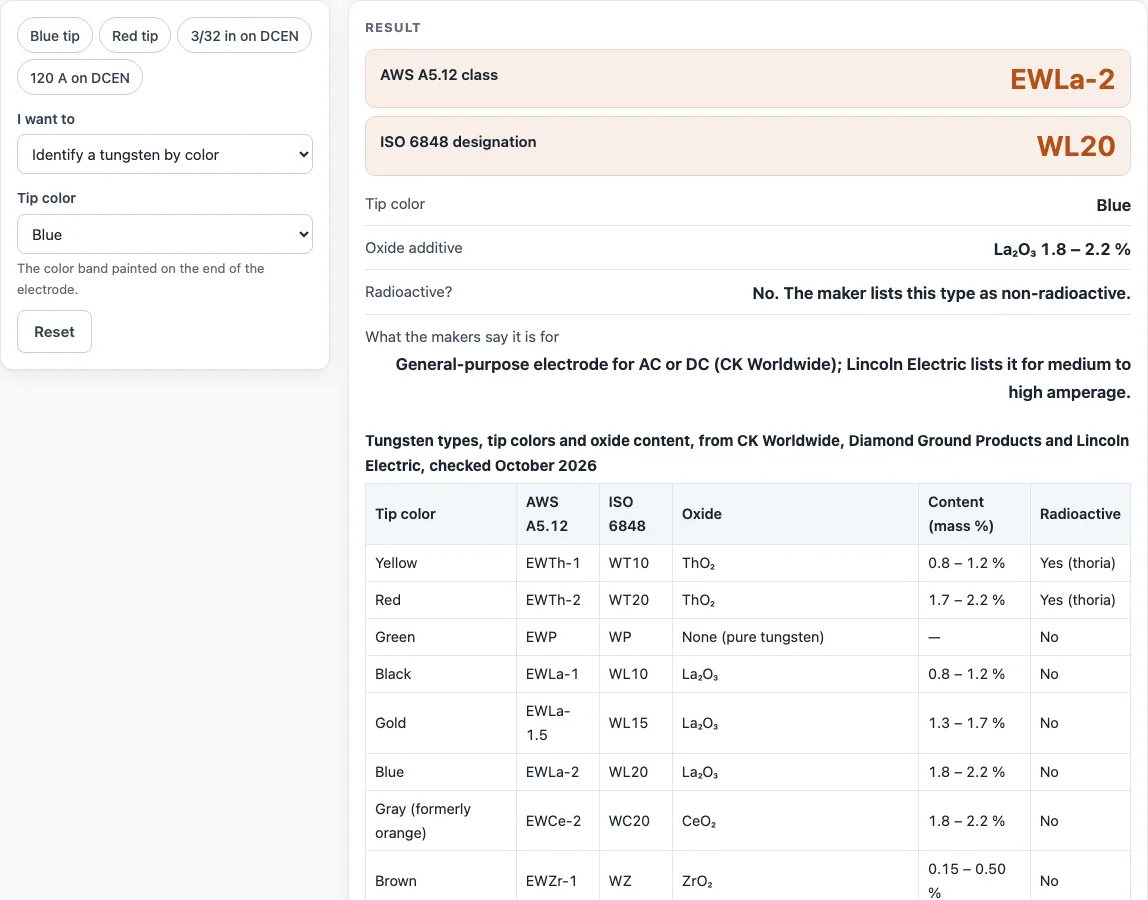
How to use the Tungsten electrode chart
- Under “I want to”, pick Identify a tungsten by color, Find the current for a diameter, or Find the diameter for a current.
- To identify an electrode, look at the colored band painted on one end (or the packaging) and choose that tip color. The result shows the AWS class, the ISO code and the oxide percentage range for that color.
- To find a current range, choose the tungsten diameter and the current type: DC electrode negative (DCEN), or AC with 50/50 or +70/-30 balance.
- To find a diameter, enter the welding current you plan to use and choose the current type. The tool gives the smallest listed diameter that fits and names any other diameters whose ranges also cover that current.
- Read the results. Because they update as you type, change one input at a time when you want to compare options.
- Open “How it was calculated” to see the formula and each step worked out with your numbers.
When the result is what you need, use Copy result to copy the result lines with a link, or Copy link to copy the page address. That address stores every input in the ?s=… part, so opening it later restores the same calculation. For a paper record, Print / save as PDF prints the inputs, results, calculation steps and the date.
What do the tungsten colors mean?
Each tip color marks the oxide added to the tungsten, and that additive changes how the electrode starts, runs and wears. Pure tungsten has no additive and is green. The additive colors are red for 2% thoriated, blue for 2% lanthanated, gold for 1.5% lanthanated, black for 1% lanthanated, gray for 2% ceriated, brown for zirconiated EWZr-1 and white for zirconiated EWZr-8.
What are the tungsten color codes for AWS and ISO (WL15, WC20, WT20)?
AWS A5.12 and ISO 6848 name the same electrodes differently. The AWS class is written as EWLa-1.5, EWCe-2 or EWTh-2, and the ISO code is WL15, WC20 or WT20. The number in the code gives the oxide percentage, so WL15 is 1.5% lanthanated (gold), WC20 is 2% ceriated (gray) and WT20 is 2% thoriated (red). In the charts used here, both standards print the same tip color for each type. The one difference we found is ceriated, which older charts show as orange.
TIG tungsten size guide: what size do I need for a given amperage?
Choose the diameter whose listed current range covers your welding current. In Lincoln’s table, a 1/16 in (1.6 mm) electrode is listed at 60 to 150 A on DCEN and 40 to 110 A on AC 50/50, while a 3/32 in (2.4 mm) electrode is listed at 150 to 250 A on DCEN. Because the ranges overlap, one current can fit more than one diameter. For 120 A on DCEN, the tool gives 1/16 in as the smallest listed size that fits. A larger electrode lasts longer at the same current but is harder to start. Lincoln does not list a 3/16 in (4.8 mm) range, so the tool shows none for that size.
What is the difference between ceriated, lanthanated and thoriated tungsten?
All three are tungsten with a small oxide added to improve the arc, and each oxide behaves a little differently. Thoriated tungsten (thorium oxide, EWTh-2, red) is the traditional red electrode, and it contains 1.7 to 2.2% thorium oxide. Lanthanated (lanthanum oxide) and ceriated (cerium oxide) are the alternatives Miller recommends over pure tungsten on modern inverter TIG machines, where green tungsten can start poorly. Lanthanated electrodes are also described by CK Worldwide as general-purpose electrodes for AC or DC.
Sources
Checked October 2026:
- CK Worldwide, tungsten specifications (colors, AWS/ISO codes, oxide content, uses)
- Diamond Ground Products, tungsten safety data sheet (EWTh-1, EWLa-1, EWZr-1 colors and oxide ranges; thoriated radioactivity) and tungsten guidebook
- Lincoln Electric, tungsten electrodes publication E3.30 (PDF): current ranges by diameter for DCEN, AC 50/50 and AC +70/-30
- Miller Electric, Guide to TIG welding basics (tungsten for inverter TIG machines)
For estimation; verify critical designs against the applicable standard.
Worked examples
| Input | Result |
|---|---|
| Blue tip | EWLa-2 / ISO WL20, La₂O₃ 1.8 – 2.2 % |
| Red tip | EWTh-2 / ISO WT20, ThO₂ 1.7 – 2.2 % |
| 1/16 in (1.6 mm) on DC electrode negative (DCEN) | 60 – 150 A |
| 3/32 in (2.4 mm) on AC, 50/50 balance | 65 – 150 A |
| 120 A on DC electrode negative (DCEN) | 1/16 in (1.6 mm), listed 60 – 150 A |
Calculated by the tool above with these values.
Frequently asked questions
Which tungsten is best for AC aluminum?
CK Worldwide lists pure (green) and zirconiated tungsten for AC welding on aluminum and magnesium. If you use pure tungsten on an inverter machine, test the arc start before you rely on it. The electrode’s package and your machine’s manual should confirm the setting you use.
Is red (thoriated) tungsten radioactive?
Yes. CK Worldwide lists 2% thoriated tungsten (EWTh-2, ISO WT20) as radioactive, and Diamond Ground Products calls it a low-level radioactive hazard. Avoid grinding it without ventilation, keep dust out of your breathing zone, and follow your local rules for disposal.
Why does my electrode color not match the chart?
Blends that do not fit the standard classes fall under EWG, and their color depends on the maker. For example, CK Worldwide’s Layzr is chartreuse, Lincoln’s WX Multi-Oxide is purple and Diamond Ground’s Tri-Mix is cream. Check the label or the maker’s chart to confirm the oxide.
Why does my result show a different diameter than I expected?
The ranges overlap, so the tool shows the smallest listed diameter that fits and names the others. Other makers print different ranges, so the figures on your electrode’s package may differ from Lincoln’s table.
Can I use the results at work?
Yes. Results may be used in commercial work such as quotes, welding procedure planning, shop paperwork and reports, without attribution. The tool also works on a phone.
Related tools
- TIG amperage chart: use it to check the amperage range for your material and joint before you choose an electrode.
- TIG cup size chart: use it to match a gas cup to your electrode diameter.
- TIG filler rod chart: use it to pick a filler rod to go with your base metal.
- Welding shade chart: use it to choose a lens shade for your welding process and current.
- Metal melting point chart: use it to compare the melting points of the metals you are joining.
- All welding calculators: use it to browse the other welding tools on this site.