Welding Cost Calculator
Enter the weld size and length with your deposition rate and prices to get the filler, time and total cost of a weld.
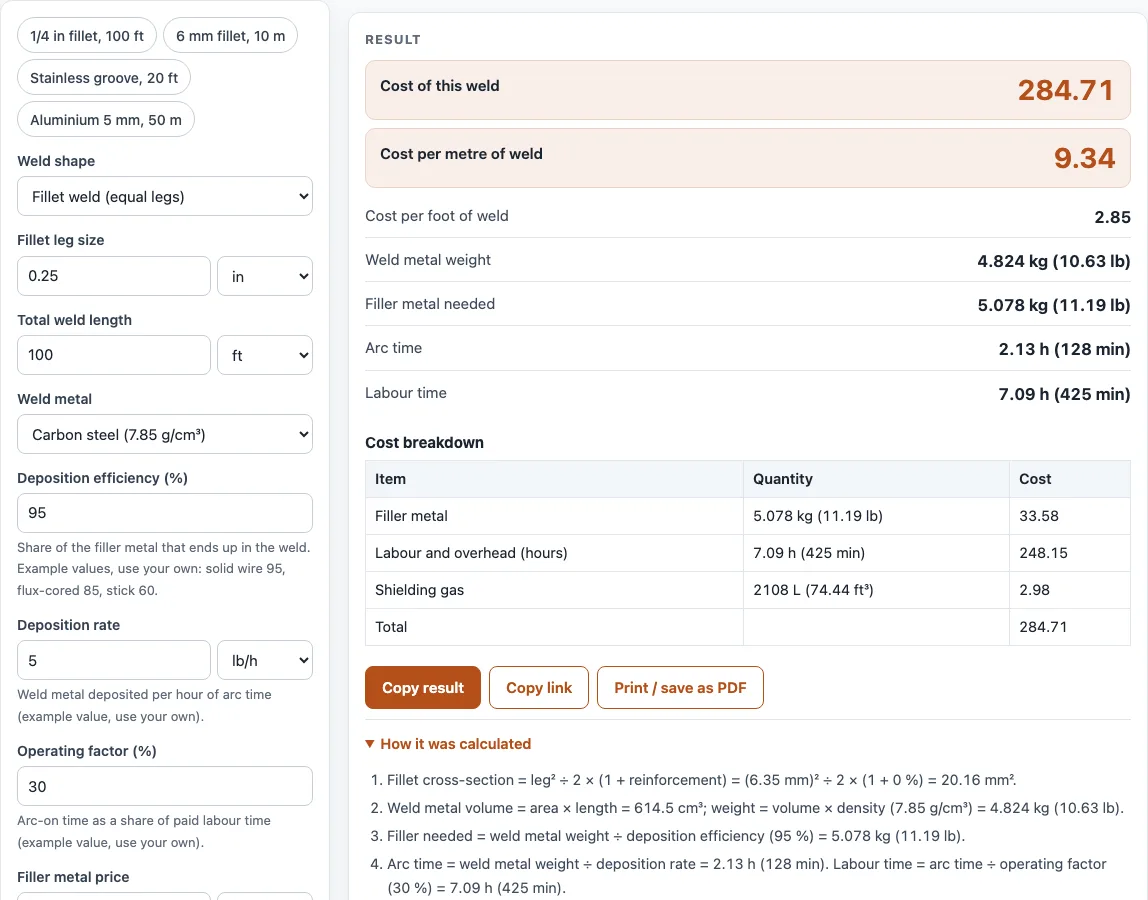
A welding cost calculator estimates what a weld will cost before you start welding. You enter the weld shape and size, its length, the metal type, and your filler and labour prices, plus optional gas, overhead and power figures. It then returns the total cost, the cost per metre and per foot, the weld metal weight, the filler needed, the arc time and the labour time.
The tool runs in your browser, so nothing you enter is uploaded. It is free, needs no sign-up, and works on a phone. Results update as you type, which makes it easy to compare options for the same joint, such as a smaller fillet against a larger one, or carbon steel against aluminium. All money values are plain numbers in your own currency, so you can use them directly in a quote or shop paperwork.
How to use the Welding Cost Calculator
- Choose the weld shape: an equal-leg fillet or a groove weld.
- For a fillet, enter the leg size. If you want extra weld height included, enter a reinforcement percentage. For a groove weld, enter the cross-section area in mm² or in².
- Enter the total weld length.
- Select the metal type: carbon steel (7.85 g/cm³), stainless steel (8.0 g/cm³), aluminium (2.70 g/cm³), or enter your own density.
- Enter the deposition rate in kg/h or lb/h.
- Enter the deposition efficiency and the operating factor.
- Enter the filler price and the labour rate.
- Open More options if you need them. Add shielding gas flow and gas price, an overhead rate, or welder power in kW and electricity price. Leave these out if they do not apply.
- Read the results: total cost, cost per metre and per foot, weld metal weight, filler needed, arc time, labour time and the breakdown table.
- Open “How it was calculated” to see the formula and each step with your numbers.
The default values are examples only, so replace them with your own. Copy result copies the result lines with a link. Copy link copies the page address, which stores every input, so opening it later restores the same calculation. Print / save as PDF prints the inputs, results, calculation steps and the date.
How do you calculate welding cost?
Welding cost is the sum of filler metal, labour and any optional gas, overhead and power costs. Each part depends on the weld’s size and length, so the calculation starts with the weight of metal in the weld. The total is: filler × filler price + labour time × (labour rate + overhead rate) + shielding gas flow × arc time × gas price + welder power (kW) × arc time × electricity price. If gas, overhead or power do not apply to your job, leave them at zero.
How much filler metal do I need for a weld?
Filler needed equals the weld metal weight divided by the deposition efficiency. The weld metal weight is the metal left in the finished weld, but some wire is lost as spatter and stub ends. That loss is why you always need more filler than the weld contains. For example, a weld with 1.41 kg of weld metal at 90% efficiency needs about 1.57 kg of filler.
How do you calculate the weight of weld metal?
Multiply the cross-section area by the total weld length and by the metal density. For an equal-leg fillet, the cross-section area is leg² ÷ 2, plus any reinforcement percentage you add. Use consistent units: cm² × cm × g/cm³ gives grams. For a 6 mm fillet over 10 m, the area is 18 mm², or 0.18 cm². The length is 1,000 cm, so the volume is 180 cm³. At 7.85 g/cm³ for carbon steel, the weight is 1,413 g, or about 1.41 kg.
What is deposition efficiency?
Deposition efficiency is the share of the filler metal that ends up in the weld. The rest is lost as spatter, slag and stub ends. A lower efficiency means you must buy more filler for the same weld, which raises the filler cost. Enter the figure that matches your process and practice, since it changes the filler needed.
What is operating factor in welding?
Operating factor is the share of paid time that a welder spends with the arc on. The rest goes to setup, grinding, moving between joints, changing wire and breaks. Labour time equals arc time divided by operating factor. For example, 2 hours of arc time at a 25% operating factor means 8 paid hours. A low operating factor makes the same weld cost more in labour.
How do I estimate welding cost per foot?
Divide the total cost by the weld length in feet. In the worked example, a 1/4 in fillet, 100 ft long, in carbon steel gives a total of 284.71 with the example inputs. Divided by 100 ft, that is 2.85 per foot. The same method works in metres: divide the total by the length in metres. The tool shows both figures, so you can also change the length and read the new per-foot cost directly.
Sources
Checked October 2026:
- Fabricating & Metalworking, Estimating total welding costs: operating factor and the cost build-up from weld metal, filler, labour and gas
- Material Welding, deposition efficiency: GMAW 93–98 %, FCAW 75–85 %, SMAW about 60 %
- All prices and rates on the page are example inputs, not market prices: enter your own
For estimation; verify critical designs against the applicable standard.
Worked examples
| Input | Result |
|---|---|
| Fillet weld (equal legs) 0.25 in, 100 ft, Carbon steel (7.85 g/cm³) | 284.71 (9.34 /m, 2.85 /ft) |
| Fillet weld (equal legs) 6 mm, 10 m, Carbon steel (7.85 g/cm³) | 65.21 (6.52 /m, 1.99 /ft) |
| Groove weld (cross-section area known) 80 mm², 20 ft, Stainless steel (8.0 g/cm³) | 492.22 (80.74 /m, 24.61 /ft) |
| Fillet weld (equal legs) 5 mm, 50 m, Aluminium (2.70 g/cm³) | 122.15 (2.44 /m, 0.745 /ft) |
Calculated by the tool above with these values.
Frequently asked questions
Is the welding cost calculator free to use?
Yes. It runs in your browser, needs no sign-up, and does not upload what you enter. It also works on a phone.
Can I use the results in a quote or shop paperwork?
Yes. Results may be used in commercial work, including quotes, welding procedure planning, shop paperwork and reports, without attribution.
Why does labour often cost more than the filler?
In manual welding, labour is usually the biggest cost, so arc time and operating factor often matter more than the filler price. Change the labour rate and operating factor to test this with your own numbers.
Can I use the calculator for aluminium or stainless steel?
Yes. Choose aluminium (2.70 g/cm³) or stainless steel (8.0 g/cm³) as the metal type, or enter your own density.
Does it work for groove welds?
Yes. For a groove weld, enter the cross-section area in mm² or in² instead of a leg size.
Where do I get the deposition rate?
From the wire or electrode maker’s data for your size and settings, or from your own timed test welds.
Does it include fit-up and grinding time?
Only through the operating factor: a lower operating factor adds non-arc time such as fit-up, grinding and moving between joints.
Related tools
- MIG wire size chart: use it to choose a wire diameter before you estimate filler use.
- Heat input calculator: use it to check the heat put into a weld for a given procedure.
- Weld strength calculator: use it to estimate the load capacity of a weld you are costing.
- Stitch weld calculator: use it when you plan intermittent welds and need to compare total weld length.
- Welding cable size chart: use it to pick cable sizes for the welding circuit and its power draw.
- All welding calculators: use it to browse every calculator on the site.