Welding Positions Chart
Choose the weld type, plate or pipe, and the orientation to get the AWS position code, the ISO 6947 code and a drawing.
This welding position chart shows the standard positions for plate and pipe welds and gives the AWS/ASME code and ISO 6947 designation for the position you choose. It runs in your browser, is free, needs no sign-up, and works on a phone.
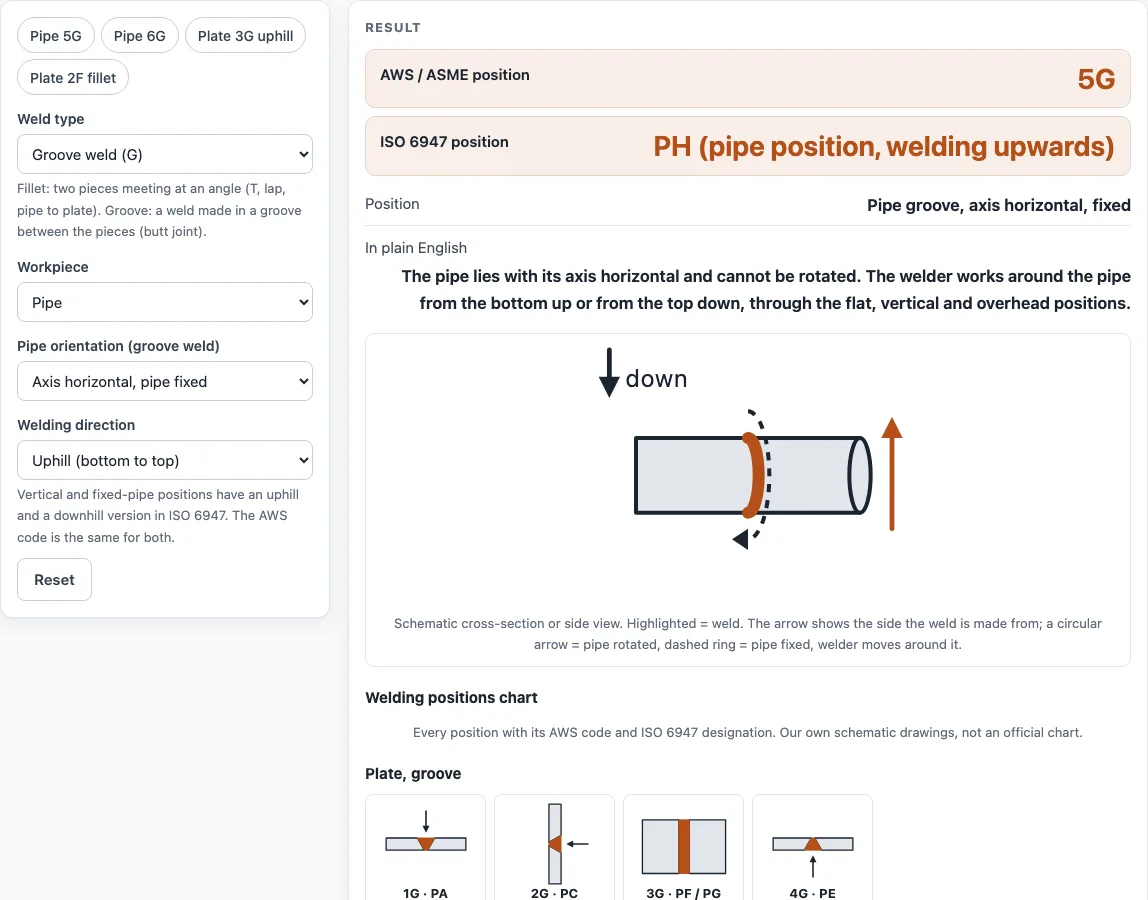
You pick the weld type, plate or pipe, and the orientation. Below the result, the full welding positions chart shows all 19 plate and pipe positions as small drawings with their AWS and ISO codes, so you can compare them or print the chart for training. The result updates as you change an input, and the chart shows every position in a grid with a schematic drawing of the one you selected.
How to use the welding position chart
- Choose the weld type: fillet or groove.
- Choose plate or pipe.
- Pick the orientation from the list. For plate, the options describe how the weld runs, such as “Horizontal: weld runs sideways” or “Vertical: weld runs up or down.” For pipe, the options describe the pipe axis and whether the pipe is rotated, fixed, or inclined about 45°.
- If the result is 3G, 3F, 5G, 5F or 6G, choose the welding direction (uphill or downhill). The AWS code is the same either way, but ISO gives each direction its own designation.
- Read the result. It shows the AWS/ASME code and the ISO 6947 designation, plus the drawing of the chosen position.
- Open How it was calculated to see the rule and each step with your inputs.
- Scroll down to the grid of all positions to compare plate and pipe codes at a glance.
The page address stores every input, so you can bookmark it or share it to reopen the same calculation. Copy link copies that address, and Copy result copies the result lines with a link. Print / save as PDF prints the inputs, results, calculation steps and the date, which is useful for shop paperwork.
What are the welding positions?
The welding positions are four standard orientations for a weld: 1 flat, 2 horizontal, 3 vertical and 4 overhead. In the AWS/ASME code, the number is the position and the letter is the weld type, with F for fillet and G for groove. ISO 6947 uses its own letters: PA flat, PB horizontal vertical, PC horizontal, PD horizontal overhead, PE overhead, PF vertical welding upwards and PG vertical welding downwards.
What does 1G, 2G, 3G, 4G mean in welding?
These are AWS codes for groove welds on plate, where the G stands for groove and the number gives the position. 1G is flat, 2G is horizontal, 3G is vertical and 4G is overhead. The matching ISO designations are 1G = PA, 2G = PC, 3G = PF or PG and 4G = PE. The plate fillet equivalents are 1F to 4F, with the same numbers for position.
What is the difference between 5G and 6G pipe welding positions?
Both are groove welds on a pipe that stays fixed, so the welder moves around the pipe rather than turning it. In 5G the pipe axis is horizontal, so the weld runs around a horizontal pipe. In 6G the pipe is inclined about 45°, which adds an angle that a 5G weld does not have. The ISO equivalents are PH or PJ for 5G and PH-L045 or PJ-L045 for 6G, with PH or PJ chosen by welding direction (upwards or downwards). The scope text of ISO 6947 also writes them as H-L045 and J-L045. A variant called 6GR adds a restriction ring. It has no row in the ISO 6947 comparison table, so the tool shows only the AWS code for it.
What is the ISO equivalent of 3G / 6G (PF, PH-L045)?
A 3G plate groove weld corresponds to PF when welding upwards and PG when welding downwards. The AWS code does not separate the two directions, which is why the tool asks you to choose one. A 6G pipe groove weld corresponds to PH-L045 when welding upwards and PJ-L045 when welding downwards. These pairings follow the comparison table in ISO 6947:2019 Annex B.
What is the difference between a fillet (F) and groove (G) position?
The F or G letter describes the joint type. A fillet weld joins two surfaces that meet at an angle, such as a T or lap joint. A groove weld fills a gap in a prepared joint, such as a butt joint. The position number is separate from this. ISO 6947 states that welding positions do not depend on joint geometry. They depend on the slope of the weld axis and the rotation of the weld face. So a fillet and a groove can share the same orientation and the same position number.
Sources
Checked October 2026:
- ISO 6947:2019, Annex B Table B.1 (AWS/ISO comparison) and Figure 1 (position key), copy hosted by SSAB
- Lincoln Electric European consumables catalogue, welding positions table (PDF)
- Miller Electric, What are the 4 basic welding positions
- Lake Washington Institute of Technology, Pipe Welding, chapter 10 (pipe orientations, 6GR)
The drawings are our own schematics, not copies of the standard’s figures.
Worked examples
| Input | Result |
|---|---|
| pipe groove weld, Axis horizontal, pipe fixed | AWS 5G, ISO PH (pipe position, welding upwards) |
| plate groove weld, Vertical: weld runs up or down | AWS 3G, ISO PF (vertical position, welding upwards) |
| plate fillet weld, Horizontal: weld runs sideways | AWS 2F, ISO PB (horizontal vertical position) |
| pipe groove weld, Axis inclined 45°, pipe fixed | AWS 6G, ISO PH-L045 (pipe inclined 45°, welding upwards) |
| pipe fillet weld, Axis horizontal, pipe rotated | AWS 2FR, ISO PB (horizontal vertical position) |
Calculated by the tool above with these values.
Frequently asked questions
Is the drawing on the chart an official welding chart?
No. The drawings are created for this tool and are not an official chart. Use the AWS or ISO standard itself when you need the official definitions.
Does this chart tell me what position a welder is qualified for?
No. The chart shows the position of a weld, not a qualification. Qualification ranges are set by AWS D1.1, ASME Section IX and ISO 9606 or ISO 15614.
Why does the result sometimes show only an AWS code?
For 6GR and 6F there is no matching row in the ISO 6947 Annex B comparison table. In those cases the tool shows the AWS code only and says so.
Can I use the results in quotes or shop paperwork?
Yes. Results may be used in commercial work, including quotes, welding procedure planning, shop paperwork and reports, without attribution.
Which positions are hardest to weld?
The chart does not rank difficulty; it only identifies the position. In vertical, overhead and fixed pipe positions (3G, 4G, 5G, 6G) gravity pulls the weld pool away from the joint in a different direction than in the flat position, so each is named and tested separately.
Do I need to create an account to use the chart?
No. It is free, requires no sign-up, and nothing you enter is uploaded, since everything runs in your browser.
Related tools
- Welding symbol chart: use it to read the symbols on a drawing that call out the weld.
- Welding rod chart: use it to compare electrode choices for your process and material.
- Stick welding amperage chart: use it to find a starting current range for stick welding.
- Weld strength calculator: use it to estimate the load capacity of a weld.
- Stitch weld calculator: use it to plan intermittent welds along a joint.
- All welding calculators: use it to browse every welding tool on the site.