Welding Travel Speed Calculator
Find the travel speed that deposits your target weld size from wire feed speed, wire diameter and deposition efficiency.
This travel speed calculator for welding gives the travel speed that deposits a weld of a target size, based on your wire feed speed, wire diameter and deposition efficiency. It has three modes: travel speed for a weld size, travel speed from a measured weld length and time, and the weld size you get at a given travel speed. Results appear in in/min, mm/min, mm/s and m/min as you type.
The calculator runs in your browser. It is free, needs no sign-up, uploads nothing and works on a phone. The result is an estimate, so check it against your welding procedure and the consumable maker’s data before you rely on it. Use it to plan a weld, check a travel speed from a timed run, or confirm the weld size a set speed will give.
How to use the Welding Travel Speed Calculator
- Pick a mode: Travel speed for a weld size, Travel speed from length and time, or Weld size at a travel speed.
- Choose the wire material and wire diameter (0.023 to 1/16 in or 0.6 to 1.2 mm, as on the MIG wire size chart), or enter a custom diameter.
- Enter your wire feed speed in in/min or m/min.
- Enter your deposition efficiency as a percentage. This is your own figure: the share of the wire that ends up in the weld. 95 % is only an example value for solid wire.
- Select the weld shape. For a fillet weld with equal legs, enter the leg size and an optional reinforcement percentage. For a groove weld, enter the cross-section area.
- Enter the target for your mode: the weld size, the measured weld length and arc time, or the travel speed you want to check.
- Read the results in in/min, mm/min, mm/s or m/min. Open How it was calculated to see the formula and every substitution, including the wire feed rate and deposition rate in kg/h and lb/h.
Copy result copies the result lines with a link. Copy link copies the page address, which stores every input (?s=…), so opening it later restores the same calculation. Print / save as PDF prints your inputs, results, calculation steps and the date.
How do you calculate welding travel speed?
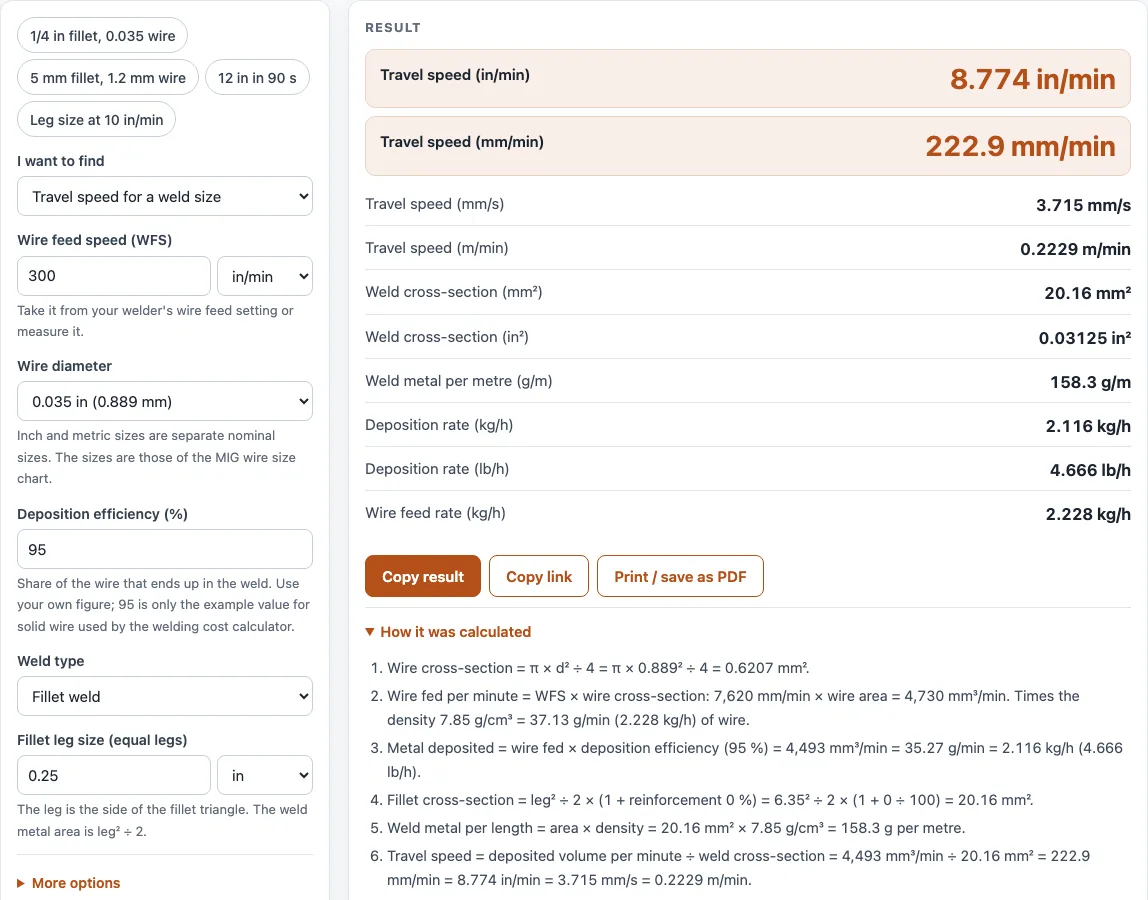
Travel speed is the volume of weld metal you deposit per minute divided by the cross-section area of the weld. The calculator works this out in three parts: the wire cross-section, the deposited volume, then the speed.
First, the wire cross-section is π × d² ÷ 4, where d is the wire diameter. Multiply it by wire feed speed to get the wire fed per minute, then multiply that by your deposition efficiency to get the deposited volume per minute. Finally, divide by the weld cross-section area: Travel speed = deposited volume per minute ÷ weld cross-section area.
For a fillet weld with equal legs, the cross-section is leg² ÷ 2, optionally increased by a reinforcement percentage. For a groove weld, you enter the cross-section area directly. The calculation assumes the whole cross-section is made in one pass at that speed, and that the wire and weld metal have the same density.
How do you calculate travel speed from weld length and time?
Divide the weld length by the arc time: travel speed = weld length ÷ arc time. The calculator then converts the result to all four speed units. For example, 600 mm of weld made in 2 min gives 300 mm/min, which is 11.81 in/min. Use the time the arc was on, not the time spent on setup or breaks.
How does wire feed speed affect travel speed?
Wire feed speed sets how much metal you deposit per minute. For a given weld size and efficiency, a higher wire feed speed means a higher travel speed, and the relationship is direct: doubling wire feed speed doubles the calculated travel speed.
Wire diameter has a stronger effect than it looks, because the wire area scales with d². A 1.2 mm wire fed at 8 m/min, with 95 % efficiency, makes a 5 mm fillet at 27.07 in/min (687.6 mm/min). Enter the wire diameter you actually run, and the wire feed speed from your machine’s settings or your own measurement.
Sources
Checked October 2026:
- Wire diameters and densities: the same sources as the MIG wire size chart (wire maker listings; steel 7.85, stainless 8.0, aluminum 2.70 g/cm³)
- Travel speed = weld length ÷ arc time, and deposited volume = wire area × wire feed speed × efficiency: geometry; 1 in = 25.4 mm exactly (NIST SP 811)
For estimation; verify critical designs against the applicable standard.
Worked examples
| Input | Result |
|---|---|
| 0.035 in wire at 300 in/min, 95 % efficiency, 0.25 in fillet | 8.774 in/min (222.9 mm/min) |
| 1.2 mm wire at 8 m/min, 95 % efficiency, 5 mm fillet | 27.07 in/min (687.6 mm/min) |
| 1.0 mm wire at 10 m/min, 90 % efficiency, 50 mm² groove area | 5.566 in/min (141.4 mm/min) |
| 600 mm of weld in 2 min | 11.81 in/min (300 mm/min) |
| 0.035 in wire at 300 in/min, 95 % efficiency | leg 5.948 mm (0.2342 in) at 10 in/min |
Calculated by the tool above with these values.
Frequently asked questions
What travel speed do I need for a 1/4 in fillet weld?
The answer depends on your wire feed speed, wire diameter and deposition efficiency, so there is no single figure. With 0.035 in wire at 300 in/min and 95 % efficiency, the calculator gives 8.774 in/min (222.9 mm/min) for a 0.25 in fillet. Enter your own values in travel speed mode to get your result.
How do I find the fillet size I will get at a given travel speed?
Switch to Weld size at a travel speed and enter your travel speed. The leg is √(2 × area ÷ (1 + reinforcement)), where the area is the deposited volume per minute divided by the travel speed. For 0.035 in wire at 300 in/min, 95 % efficiency and 10 in/min, the leg is 5.948 mm (0.2342 in).
Can I use this calculator for groove welds?
Yes. Enter the cross-section area of the groove instead of a fillet size. For 1.0 mm wire at 10 m/min, 90 % efficiency and a 50 mm² groove area, the result is 5.566 in/min (141.4 mm/min). The result assumes the whole area is filled in one pass.
What deposition efficiency should I enter?
Enter your own figure, the share of the wire that ends up in the weld. 95 % is only an example value for solid wire, the same one used on our welding cost calculator. If you do not know your efficiency, check it against your process and your consumable maker’s data.
Is the result accurate enough for a welding procedure?
The result is an estimate. Check it against your welding procedure and the consumable maker’s data before you use it in production, quoting or shop paperwork.
Related tools
- Heat input calculator: use it to work out heat input from the travel speed you have.
- MIG wire size chart: use it to look up wire diameters and material densities before you enter them.
- MIG welding settings chart: use it to compare your wire feed speed with a settings reference.
- Welding cost calculator: use it to estimate the cost of the wire used for a weld.
- Weld strength calculator: use it to check the strength of a weld once you know its size.
- All welding calculators: use it to find the other calculators on this site.